Wednesday, 24 December 2014

Hawkweed named for Sir David Attenborough

The December issue of New Journal of Botany should be with you soon after Christmas, and in it you will find a description of a new Hawkweed from the Brecon Beacons, Wales. 

Tim and a Taraxacum in the Brecon Beacons
Image: C. Gait
The botanist who described this new Hawkweed is none other than Tim Rich, co-ordinator of the BSBI New Year Plant Hunt, and he has named it Hieracium attenboroughianum after Sir David Attenborough. 

Tim said "I have named this species in honour of Sir David Frederick Attenborough whose ‘World about us’ series on BBC television inspired me to study ecology when I was 17. I have watched and admired his work ever since, as have many other people and, in naming this Hawkweed, pay tribute to him for so eloquently educating us about the natural world".


Cover of NJB in 2014
Images by C. Ferguson-Smyth
You will have to wait for the December issue of New Journal of Botany to find out more and see images of the new Hawkweed, but Tim's abstract says "Hieracium attenboroughianum is a member of the H. britannicum group in Hieracium section Stelligera Zahn, related to H. britannicoides P. D. Sell, but differing in cupped, dark green leaves and sparse, medium simple eglandular hairs and many glandular hairs on the involucral bracts. About 300 plants occur on Old Red Sandstone mountain ledges on Cribyn (VC42). It is classified under the IUCN Threat Category ‘Endangered’."

If you are thinking of making a start with Hawkweeds - and be warned, they are notoriously tricky - then you will need this, the appropriate volume of this and a lot of time and patience while you work up to this! 

If you'd prefer something less challenging, we recommend a mooch around your local patch in the first few days of January and sending in your records to Tim, Ryan, me and Sarah for the New Year Plant Hunt.     

Monday, 22 December 2014

New Year's Plant Hunt on the radio

Steven, Tim & Gorse in flower
Image courtesy T. Rich
Tim Rich, Co-ordinator of the BSBI New Year Plant Hunt, was at Cardiff Bay this afternoon pre-recording an interview with BBC Radio Wales, to be broadcast on New Year's morning and then available here on iPlayer. 

Tim was able to tell journalist Steven Fairclough all about the Hunt, now in its fourth year, and some of the species we might find, based on last year's results. 

I bet they also addressed the issue of whether the plants we all recorded in flower last year indicated an early spring, or were species which flower all year round, or could be considered Autumn-flowering plants that were still going through the middle of winter. Here's Tim's analysis for last year. 


Blackstonia perfoliata in flower 22/12/2014
Image: T. Rich
Tim was able to show Steven a few wild plants in bloom today and reports finding Blackstonia perfoliata "flowering again in exactly the same spot in Cardiff Bay as it was last year. Unusual genotype or what?!" 

Apparently Tim found 28 plants in flower in about 30 minutes today. Depending on the weather, many of these could still be blooming at New Year for the Plant Hunt. Watch this space!

Wednesday, 17 December 2014

Behind the scenes in herbaria

Herbarium tour, AEM 2014
Image: L. Marsh 
If you missed out on the very popular guided tours of the University of Leicester Herbarium which so many attendants at the recent BSBI Exhibition Meeting enjoyed, you may have read yesterday's note about Peter Sell and the decades he spent in a herbarium, and thought... yes, but what exactly was he doing in there? And, more importantly, why?

There are some excellent videos around which answer those questions, offering a behind-the-scenes glimpse into what goes on at two national herbaria. This video is from RBGE and this one and this are both from Kew. 

What goes on in any herbarium is basically the same, whether it's a national collection or a cupboard in your bedroom. You are preserving a plant for future use and reference - whether that's to help your personal ID skills or for internationally-important research. That's the 'why' of herbaria - and the supporting data you include on your herbarium label covers where the specimen was found, when, by whom, growing with what... all the things you and your fellow botanists need to know about the plant you collected in the field!  

Tuesday, 16 December 2014

Publication of Volume 2 of ‘Sell & Murrell’

Image courtesy of
Cambridge University Press
Philip Oswald has been in touch to share his pleasure at receiving the most delightful early Christmas present: a copy of the newly-published, and long-awaited, Volume 2 of Peter Sell's and Gina Murrell's Flora of Great Britain and Ireland. Volume 2 is the penultimate volume of the five.

Philip told me “A small group of Peter's friends have collaborated to see this volume through the press and will soon be starting on the necessary work on the final volume of the five, Volume 1.

“This volume of 588 pages – very slightly less than in the previous one – covers the 18 families from Capparaceae and Brassicaceae (Cruciferae) to Saxifragaceae and Rosaceae, the last occupying pages 135–518 and including 173 pages with descriptions of 354 Rubus taxa.

“Sarah Holme has joined Gina Murrell in providing the line drawings for this volume, including three plates of elegantly drawn leaves of all the twenty Alchemilla species.”

Gina Murrell and Peter Sell, 2011
Image: P. Oswald
You can find out here about Peter’s many years spent in the Herbarium at Cambridge University Botanic Garden. You can also read an obituary of Peter Sell (1931-2013) and see some of the many tributes paid to him by his friends and colleagues here, here and here. Perhaps the finest tribute is the way they have collaborated to bring this Volume 2 to press.

For any British or Irish botanist keen to identify taxa below species level, the volumes of ‘Sell & Murrell’ are indispensable, so the publication of Volume 2 is certainly a cause for rejoicing. It is now available from booksellers, and Summerfield Books has it on special offer here at £105 (usually £125).

As Philip points out “The bright red cover of this volume, including a photograph of hawthorn berries, seems especially appropriate at Christmastide”.

Many thanks to Philip for the details above and to Katrina Halliday at Cambridge University Press for providing an image of the front cover of Volume 2.

Monday, 15 December 2014

Getting started with ferns - the Garnett approach

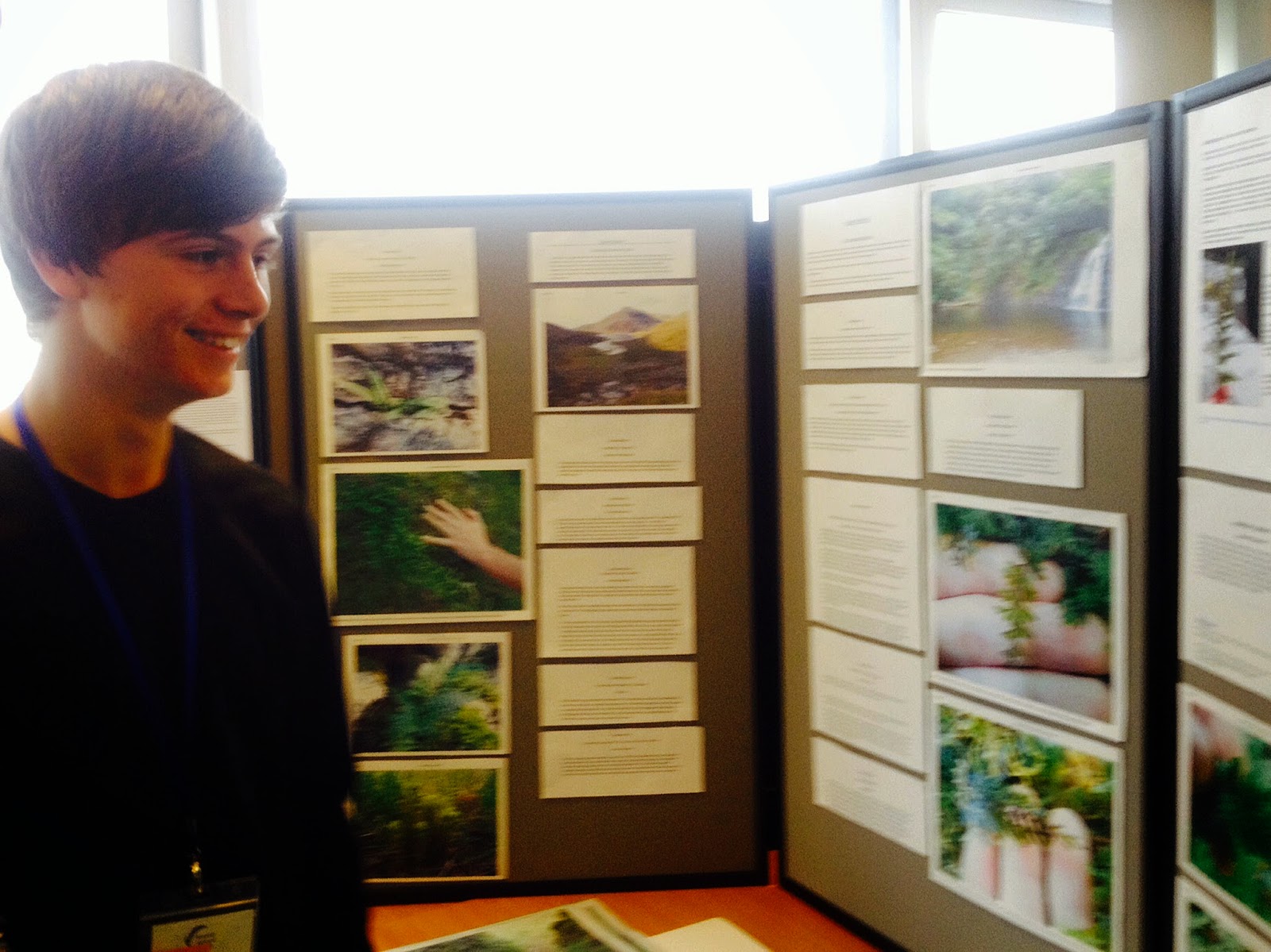
George and his exhibit at the AEM
Image: L. Hawthorne
Another of the exhibits from last month's BSBI Exhibition Meeting has been uploaded and is available here. It is a report by George Garnett on his fern finds for 2014. 

George visited sites in Wales and on his home island of Guernsey to view ferns in-situ, collecting specimens where necessary to help with identification and to add to his private herbarium collection. As a (junior) member of BSBI, he was able to consult our Fern Referee Fred Rumsey for help with identifying the trickiest specimens. 

While in the field, George was careful to adhere to Arthur Chater's guidelines on Collecting. If you want to get to grips with a plant group such as ferns, George's example would be an excellent one to follow!  

Worth pointing out that George first got involved with BSBI via last year's New Year Plant Hunt and hopes to participate again this year - as I hope you will?  

Friday, 12 December 2014

Ken Thompson: Do Plants have a Gender?

Dog's Mercury
Image: R. Clark
BSBI is in the media spotlight again today thanks to BSBI member and Telegraph Gardening blogger Ken Thompson. His column 'Do Plants Have a Gender?' was published this morning and is available here for your delight.

Ken mentions BSBI in the column (he often does this!) and quotes from several articles published in BSBI News - as he has done in previous blogs for the Telegraph. Keep up the good work, Ken, your fellow members love reading your occasional columns! 

It would probably be quite brazen of me to include a shameless plug here for Ken's most recent book, so instead here's a link to the previous one which is also excellent.  

Thursday, 11 December 2014

Importance of Ivy to Insects

Hoverfly Eristalis sp. feeding on Ivy
Image: R. Clark
The Holly and the Ivy, when they are both full-grown... are very useful to insects! Don't know about you but I hadn't realised quite how many insects rely on Ivy, especially at this time of year. 

This short piece by Ryan Clark is an eye-opener and the images are gorgeous. Ryan also gives a link to an academic paper on Ivy as an under-appreciated key resource to flower-visiting insects in Autumn.

I guess Holly is important to insects too - if a greedy Robin keeps scoffing berries, he'll be too full for even a wafer-thin insect!