Thursday, 12 April 2018

Is it ok to pick wild flowers and if so, when?

Sometimes it's best to take a photo
 of that plant and share it on social media!
Image: Mags Crittenden
Last November BSBI launched its revised Code of Conduct to help people understand when it's ok to pick wild flowers, when it definitely isn't, and what to do about all the grey areas in between! The Code, written for us by Dr Sarah Whild, botanist and lecturer in plant ecology, and Dr Fred Rumsey, Senior Curator at the Natural History Museum, has since become one of BSBI's most popular downloads. It is used by plant-lovers, whether ecological consultants or beginner botanists, keen to examine wild flowers more closely. Sometimes picking a flower is the best option!

Today our colleagues at Plantlife, with whom we run the National Plant Monitoring Scheme, launch this year's Great British Wildflower Hunt. To help wildflower-hunters, they have produced a short Code of Conduct based on BSBI's fuller version. The Plantlife Code also recommends the Rule of One in Twenty as promoted by Sarah and Fred - if you can't see more than 20 of a particular plant then definitely don't pick it!


Luronium natans - don't pick
this one, it's mega-rare!
Image: Sarah Whild
The Great British Wildflower Hunt joins the New Year Plant Hunt, Wild Flower Hour and Herbology Hunt as another way to get out and start spotting and identifying wildflowers. All these initiatives offer support in the way of spotter sheets or online help or ID tips and advice delivered via social media. You can find out more about how to get started with wildflower ID here on BSBI's Get Involved page which also has suggestions of useful Facebook groups, where to find a handlens (essential to see tiny flower characters) and a review of ID books in print.

But today is all about the launch of the Great British Wildflower Hunt and Plantlife President Rachel de Thame tells us more: "I knew my cowslip from my cow parsley and yes, I used to love picking little posies. So much of our wildlife is untouchable but common wild flowers and plants are different. I’ve gone on to teach my children and to nurture this relationship with our native flora that is fascinating, joyful and yes, important. The Great British Wildflower Hunt, with it’s helpful ID tips, can give us all confidence to identify flowers and also provides Plantlife with much needed information about how well they are doing.


Ambroise gets in there with his trusty hand-lens!
Image courtesy of Ambroise Baker  
"What we know and love we are more likely to conserve. It’s about children starting a relationship with wild flowers. It’s in a child’s instinct to collect, but today that means collecting stickers, toys or those must-have gadgets. Yet it wasn’t so long ago that children were just as keen to collect wild flowers, whether it was to take a posy home, press them, or make petal perfume, they were part of children’s everyday life. We need to ensure that this next generation is just as engaged and passionate so they will understand why wild flowers need to be cherished and protected for not only the beauty they bring to our lives but for their vital role as life support to all our wildlife." 

So please head over to the Great British Wildflower Hunt webpage to find out more. And if you are a more advanced botanist already working flat out recording for Atlas 2020, please consider recommending the Great British Wildflower Hunt to any beginner botanists you know - it's a great way to get involved with botany!   

Tuesday, 10 April 2018

BSBI supporting Young Darwins again in 2018

BSBI is once again supporting the Young Darwin Scholarship (YDS) this year. The scheme is run by the Field Studies Council (FSC) and aims to "support young people to deepen their passion for natural history and find their value and place in our world". 

I asked Jennie Comerford, the FSC's National Grants Officer, to tell us more. Over to Jennie:

"The scholarship continues to attract young people who surprise us with the depth of their passion for the natural environment and the knowledge they have already accrued for their young age. We asked the 2017 cohort what they hoped they would get out of their scholarship and some common themes emerged in their replies:
  • Better identification of plants
  • Learn more about conservation
  • Increase my general knowledge of nature as I usually don’t have an opportunity to do so and help decide whether I want to do ecology at Uni
  • Meet some new people who have similar interests and have fun together
  • Increase knowledge of entomology
  • Get connected with other YD scholars and experts and the FSC
  • Become better at recording field studies and pick up more refined field techniques.
"The group spent time investigating a variety of habitats, management styles and geological influences. They enjoyed visits from a number of professionals in the environmental sector who shared their career journeys and influences. And there was an exciting session looking at the bigger picture with discussions such as the impact of Brexit on the environment and how to involve more young people in environmental campaigning.

"The Scholarship is a unique opportunity and we now have over 100 YDS alumni with the scheme in its 7th year. Our first cohorts have graduated and many are now at early stages of their careers in the sector. They remain involved through various social media platform groups".

One of last year's Young Darwins, Oliver Spacey, wrote a personal account of his experience and he kindly agreed to share it  with News & Views readers. Over to Oliver:

"Have you ever sat alone on a patch of grass, simply watching, listening and absorbing all the environment has to offer? If not, then that is far from uncommon and you may even think it slightly peculiar. I too had not experienced this myself until very recently, when the FSC allowed me to enter the remarkable mind of a 19th century naturalist and reconstruct my perspective of the natural world. If, in fact, you have had the luxury of sitting and observing your natural surroundings for even a mere five minutes, you will empathise with the fascination for wildlife that the FSC inspired in me when I participated in a five-day introductory course to the Young Darwin Scholarship, a unique opportunity offered to keen naturalists to support them for the future.

"Having been one of the fortunate fifteen young people that received the scholarship in 2017, I am now part of an extensive network of contacts including experts and other scholars, yet I did not quite realise how invaluable this support would be until I took part in the “What would Darwin do today?” residential at the picturesque Preston MontfordField Centre near Shrewsbury.

"Upon my arrival, any apprehension was soon abandoned as introductions and short team-building investigations revealed the many similar interests we shared, highlighting the mutual passion that is at the heart of the scholarship. In only several hours, it seemed odd to think we had previously been strangers, and our synergy was to be an integral part of both the residential and the scholarship as a whole. Activities over the next few days ranged from the exploration of a disused lead mine at Snailbeach (that was one for the geologists!) to a rather therapeutic walk across the impressive terrain of the Stiperstones, where we kept an eye out for red grouse scurrying about the heath moorland and listened intently to the entertaining folklore behind the mystic landscape. Furthermore, we were collectively rather successful at overnight mammal trapping before canoeing down the River Severn, past the birthplace of Charles Darwin himself, to ‘kick sample’ for aquatic invertebrates. On this adventure we revelled in the deep blue flashes of kingfishers darting past and even got a glimpse of a buzzard from only several feet away! 

"Bat detecting, birdwatching and inspirational talks from ecologists were appreciated by all, and a whole day was dedicated to a fast-paced BioBlitz in which we attempted to identify and record as many species as possible within a time frame. During this investigation, Henry, Adam and I were personally captivated by the revelation of the mysterious world of springtails; microscopic invertebrates that go undetected by the many yet are in truth extremely diverse and unique. After a campfire and much reflection, alas it was time to depart, not forgetting the countless unforeseen things we had learnt.

"As well as enhancing my data recording skills and my ability to identify a whole range of wildlife, the beginning of the scholarship has taught me how to make the most out of being a naturalist, and I only anticipate how it will help me in the future with a myriad of opportunities to come. And if you ever do find yourself sat alone in your garden, or leaning against an oak surrounded by woodland, or anywhere in the vast outdoors, connecting with your environment, then you will learn what the FSC’s scholarship has taught me above anything else; there will always be more to learn about nature, the trick is to never stop discovering".

Many thanks to Jennie and Oliver for these accounts and to the BSBI membership for their continued support for the Young Darwin Scholarship. You can read here and here about how BSBI has supported YDS in previous years, including in 2017 when George Garnett [also the youngest person ever to address the BSBI's Annual Exhibition Meeting] enjoyed the YDS experience and shared his Diary of a YDS on these pages.

Saturday, 31 March 2018

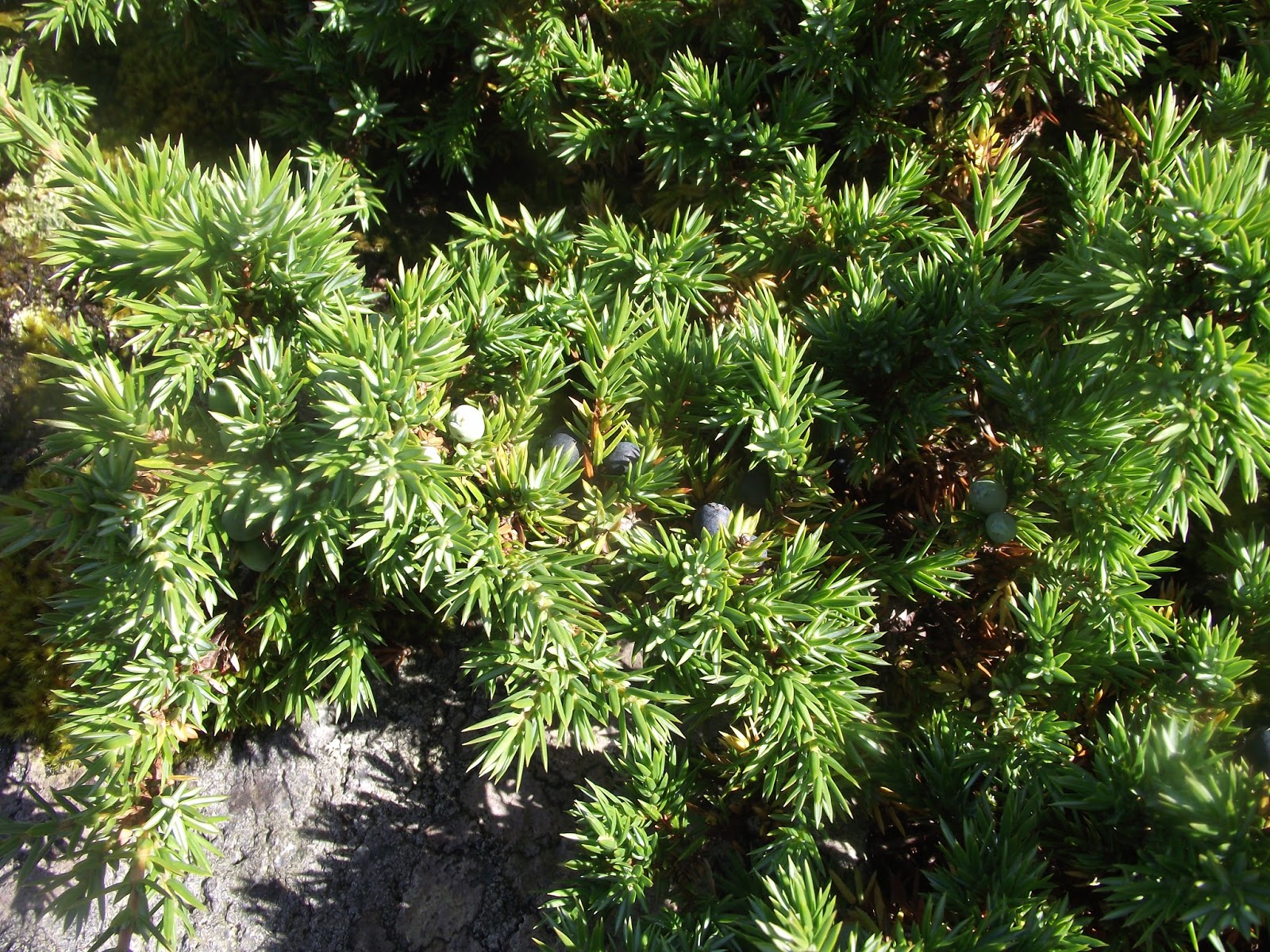
Juniper: in Byron's Gin and on the BSBI's Database

Juniper photographed in the Outer Hebrides
Image: Paul Smith 
This month's post about Byron's Gin focuses on a plant without which - well, gin just wouldn't be gin! Juniper is an essential ingredient in gin but did you know that it is a plant in decline across Britain and Ireland? 

This BSBI distribution map shows where Juniper has been recorded over time. It was one of the species studied under the BSBI's Threatened Plants Project (TPP). If you have a copy of Threatened Plants in Britain and Ireland, the recent publication which arose out of the TPP, you'll be able to read more about the factors driving the decline of Juniper, especially in lowland areas in England: Juniper is listed as Near Threatened on the England Red List
You can also read more about Juniper in this factsheet from Plantlife and on the Woodland Trust's website.

While most of the botanicals used in Byron's Gin are harvested sustainably in the distillery's grounds and nearby surroundings, the juniper is sourced from further afield to avoid impacting negatively on local populations. So you can drink Byron's Gin with a clear conscience! And don't forget that for every bottle of Byron's Gin sold, a contribution is made to BSBI's training programme, helping us to train and support the next generation of botanists.

Thursday, 29 March 2018

Invasives Week: plants of concern

Parrot's-feather
© NNSS Crown Copyright 2009
23rd - 29th March is Invasives Week and the focus is on plants that government agencies and conservation bodies need to know about, so that suitable action can be taken. 


Throughout the week you can follow the #InvasivesWeek hashtag to find out about some of the organisations taking part in this awareness-raising week, the resources they are offering and the species to look out for.

We asked Stan Whitaker from Scottish Natural Heritage to tell us more. 

Over to Stan:    

Water-primrose
© Trevor Renals
"The European Union has placed some of the most invasive alien plants on a list of species of Union concern


"More than half of the British flora consists of alien plants but the vast majority coexist harmlessly with our native plants. Only a small minority become invasive and seriously affect our native wildlife and environment.  

Floating pennywort
© NNSS Crown copyright 2009
"There are species alerts for water primrose and various-leaved water-milfoil, which have already choked waterways on the continent. 

"Please report sightings urgently, so that they can be eradicated before they do the same here. 

"In Scotland, Floating pennywort and Parrot’s-feather are being eradicated, thanks to BSBI records. We also want to tackle Giant-rhubarb on the west coast and islands, and need your help to find out where it grows.  

"Perhaps American skunk-cabbage is too widespread to eradicate everywhere, but your records can help to protect vulnerable habitats from invasion.

American skunk-cabbage, West Loch Tarbet
© David Knott
"Records of other high-impact alien plants will help with monitoring aquatic habitats, under the Water Framework Directive. Not all sites will be priorities for control but your records will help us to build our knowledge and to prioritise future action." 

Many thanks to Stan for alerting us to these invasive plants, some of which (e.g. the Giant-rhubarb Gunnera tinctoria) have featured previously on these pages

It's good to hear confirmation that BSBI records are helping in the fight to eradicate these invasive plants. You can also read more about invasive plants in papers such as this one, co-authored by Kevin Walker, BSBI's Head of Science.

Wednesday, 28 March 2018

Botanical art class at the Linnean Society

Artwork by Maria Sibylla Merian
© The Linnean Society of London
We are always keen to promote the excellent work of the Linnean Society of London to News & Views readers - as the world's oldest active biological society (they were founded in 1788) they are one of the few societies who can make the BSBI feel like a young upstart: we've only been around since 1836!

So it was a pleasure to hear from Joe Burton, the Linnean Society's Education and Public Engagement Manager, about a new botanical arts class they are offering. 

Over to Joe to tell us more:

"The Linnean Society is offering a one-day painting course on the 10th April, led by professional artists, Rebecca Jewell and Sandy Ross Sykes. The watercolour workshop will start with a special viewing of the Linnaean collections in the vault, along with an exploration of some original artwork in the beautiful library, and participants will then work on drawing the specimens in the newly built Discovery Room.

"More information here: www.linnean.org/art

Thanks Joe - we'll leave you with a peek behind the scenes into the Linnaean strongroom:


Tuesday, 27 March 2018

Coming soon: Wild Flowers of The Isle of Purbeck, Brownsea & Sandbanks, 2nd. ed.

Early Spider-orchid:
a Purbeck speciality
Image: Edward Pratt
Botanists have a treat coming up - a second edition of The Wild Flowers of The Isle of Purbeck, Brownsea and Sandbanks is about to be published and BSBI members will be able to benefit from a discounted special offer on the price. Author Ted Pratt tells us a little more:

"This is not a Flora of the usual kind, but it is a book which is perhaps the first of its style, in that it directs readers precisely to the less common plants – of which there are many in this area. It describes where they may be seen on land which is open to the public - by roads, bridleways, and paths, and in open access downland, woods and heaths, of which there are plenty in Purbeck. Sites are often given to the nearest 10 metres!  - except for a very few of the rarest species which might be dug up.

"Twenty-four hand-drawn maps show all the location reference points used in the lists of sites for a species, e.g. “SE side of road through Great Wood in several places”; also use is made of the county council parish numbering scheme for bridleways and paths, e.g. “E of path 13 75m S of junctions of paths 13 and 14”. The book was written for beginners as well as for others, so map references are only used when really necessary, for example in the middle of a heath.

Hand drawings of Turkey Oak
leaves from the forthcoming book.
Courtesy of Edward Pratt
"The first edition was published ten years ago, and, after being enthusiastically reviewed in various publications, it has sold out! It covered over 1200 species; in the second edition 81 more taxa have been added to those. There are several other additions, including a Quick Guide to finding a species, and location maps both of the 39 flower-rich sites described in the introduction, and of the 48 special seasonal sites (sites with a Wow! factor), and of the 22 suggested walks.

"Although it is not primarily an identification book, help is given with distinguishing similar species, e.g. of Zigzag Clover Trifolium medium it says “It has shortly stalked heads (compare Red Clover above), and leaves hairless on the upperside. Stems are only slightly zigzag and usually hidden by other vegetation.” There are occasional hand drawings of points not found in identification books, e.g. a drawing of five different shapes of Turkey Oak Quercus cerris leaves, and another of eight different shapes of Grey Willow Salix cinerea leaves, and another showing the shapes of Adria and Trailing Bellflower leaves Campanula portenschlagiana and C. poscharskyana, and another showing how to identify Hybrid Reedmace Typha x glauca. There are also 129 colour photographs.


Autumn Lady's-tresses
Image: Edward Pratt
"The author has received a number of expressions of appreciation from those who have brought the book on their holidays in this beautiful part of Britain".

Many thanks to Ted for telling us about this forthcoming title. If you are not a BSBI member you will still be able to buy a copy of Wild Flowers of The Isle of Purbeck, Brownsea and Sandbanks 2nd. ed. from all reputable natural history book-sellers but you won't be able to benefit from the discount. 

There are several other titles due for publication this year for which a discount will be offered to BSBI members so if you'd like to find out more about all the benefits of BSBI membership, head over here.

Wednesday, 21 March 2018

Garden plants: a threat to the environment due to climate change?

Last time Tomos Sion Jones appeared on these pages, he was telling us about an orchid course he was able to attend thanks to a BSBI Training grant

A year on and Tomos has started his PhD and now he wants to reach out to BSBI County Recorders. Over to Tomos: 

"Calling all BSBI Vice-County recorders (VCRs)! I’m a PhD student at the University of Reading, investigating the possible impacts of climate change on the distribution of garden plants and what threat garden plants present to the environment. Most garden plants are expected to have an increasing geographic range in the future. This could be a result of climate change. I’m interested in garden plants which have escaped ‘beyond the garden fence’. In particular, the factors influencing their transition along the introduction-naturalisation-invasion continuum (Richardson et al., 2000):
The introduction-naturalisation-invasion continuum. Red arrows show the transition processes and the black arrows represent the factors that influence the processes. Adapted from Levine et al. (2004:976) and Milbau and Stout (2008: 309).

Proportion of returned VCs 
(excl. the Channel Isles)
Data: OS data © Crown copyright
 and database right (2017)/
© OpenStreetMap contributors (2015).
"The initial element of this project is an online survey for BSBI VCRs. So far I’ve received completed surveys for 18 (of the 153) vice-counties across Britain and Ireland. The preliminary results from this survey are very interesting - especially on the ‘top five’ garden plants of increasing concern in each vice-county. That is, garden plants which are showing signs of naturalising or having invasive potential. Some of the results, such as Gunnera spp., are not a surprise. 

"However there are also results that I wasn’t expecting. For example, Narcissus spp., which are often naturalised but I wouldn’t have considered them to be of increasing concern. Also, Cyclamen hederifolium. It was introduced as early as 1597 (Stace and Crawley, 2015) and is a nice example of the ‘time-lag’ that’s often observed between introduction and naturalisation. C. hederifolium has certainly been naturalising recently but does it have invasive potential?

"It’s garden plants such as this that I’ll investigate further using ecological niche modelling. Comparing the climate of a plant’s native range with climate projections for Britain and Ireland will allow me to predict which garden plants might find future climate suitable and have an increased potential to naturalise or invade. 


Cyclamen hederifolium
Image: Meneerke Bloem / CC-BY-SA
"In the survey, VCRs are asked to rank their agreement or disagreement with the statement ‘climate change is exacerbating the impacts of garden plants on native plant species’. Interestingly, only five (27%) of respondents ‘agreed’ or ‘strongly agreed’ with the statement. This is much lower than I was expecting as I generally consider climate change as facilitating the transitioning process. However, it’s unexpected responses like this which are important for my project.


"I hope to receive completed surveys for as many vice-counties as possible so that I can compare the results for different parts of Britain and Ireland. So I encourage all VCRs to complete the survey. Many thanks to those who have already done so! If recording duties are shared for your vice-county, both/ all VCRs are welcome to complete it. If you would prefer to complete a hard-copy version, please email me with your postal address. You should read the information sheet before starting the survey. The survey will be open until Monday, 30th April [LM: this is an extension to the previous deadline]. If you have any questions, please email me.

"Please note that there’s an error which will affect VCRs for the Channel Isles. I’m afraid you’ll need to select vc112 Shetlands and leave a note on the survey explaining which of the Channel Isles you’re responsible for.

"I look forward to receiving more responses and sharing the results with the BSBI. I’ll have an exhibit at the next BSBI Exhibition Meeting and results might be used in published research".


References:
Levine, J.M., Adler, P.B. and Yelenik, S.G., 2004. A meta-analysis of biotic resistance to exotic plant invasions. Ecology Letters, 7, pp.975-989.
Milbau, A. and Stout, J.C., 2008. Factors Associated with Alien Plants Transitioning from Casual, to Naturalized, to Invasive. Conservation Biology, 22(2), pp.308-317.
Richardson, D.M. and Pyšek, P., 2012. Naturalization of introduced plants: ecological drivers of biogeographical patterns. New Phytologist, 196, pp.383-396.
Stace and Crawley, 2015. Alien Plants. London: William Collins.