Monday, 23 September 2019

BSBI News: September issue is out!

The latest issue of BSBI News, our membership newsletter, is being mailed out today to BSBI members and the electronic version is already available via the password-protected members-only area of the BSBI website. This latest issue is another corker! Editor Andrew Branson just gave me a peek inside the pages -  all 84 of them! - so here are a few of the highlights in this issue.

First of all there are two main articles focusing on a subject area of great interest to many botanists - invasive plants, whether native or alien:

A feature by Kevin Walker, BSBI's Head of Science, on 'Beyond mapping: the BSBI's work on invasive non-native species'.

A six-page feature by David Pearman et al. on 'The impact of native and alien "thugs" in semi-natural habitats'. 

Then there's a piece by Jennifer Peach about the Millennium Seed Bank's UK Flora Project.


Violet helleborine Epipactis purpurata in
Savernake, one of Wiltshire's finest woodlands
Image: Sharon Pilkington
Joshua Styles et al. tell us about the changing status of annual knawel Scleranthus annuus - in fact a photo of annual knawel graces the cover (above) of this issue of BSBI News

In 'Beginner's Corner' Jim McIntosh, BSBI Scottish Officer, demystifies GPS and using grid references.

In the regular 'Introducing my vice-county' spot, we hear from Sharon Pilkington, County Recorder for Wiltshire, about some of the beautiful plants and habitats of her local area.

There are no less than three short articles by Clive Stace, including one about 'novelties in your garden'. And of course there are country round-ups, telling us about notable plant finds across Britain and Ireland; news of first sightings of adventives and alien plants; a note from BSBI President Chris Metherell; six pages of book reviews, including one on 'Invasive Aliens'; letters from members; notes about what's coming up in the BSBI calendar...


Marsh spurge Euphorbia palustris found in
Gray Wood, East Sussex
Image: Helen Proctor
Inside each copy of this issue of BSBI News you will also find flyers so you can book for forthcoming events such as the BSBI Annual Exhibition Meeting and the Scottish Botanists' Conference; you'll also find three flyers about new BSBI publications which tell you how you as members can benefit from exclusive money-saving special offers. 

We'll be celebrating BSBI publications by featuring interviews with the authors of these new books in the next few days so watch this space!

But finally - this issue of BSBI News is notable for another reason: it's the final one with Editor Andrew Branson at the helm. 


Scottish primrose Primula scotica: a small
colony was found this summer on Hoy -
12km from the nearest known colony
on Orkney mainland!
Image: John Crossley
Andrew has been a BSBI member since 1988 and was publisher and editor of the prestigious British Wildlife for almost 25 years before he took over the editorship of BSBI News two years ago. In his final editorial, Andrew acknowledges the help and support over the past two years of regular contributors and "particularly Gwynn Ellis", his predecessor as editor on whose sterling work Andrew was able to build as he took BSBI News into a new era, revamping the lay-out and introducing new regular slots and full colour images throughout. 

Andrew is now handing over the reins to John Norton, who some of you will know as the man behind the excellent Flora News for the Hampshire Flora Group. Andrew tells me that he has already been able to get out and do more recording for Atlas 2020. And his future plans? He said "I'm looking forward to tramping the fields and hills of Somerset recording bryophytes later in the year, as well as doing more field work with the Dorset Flora Group (I was Chair between 2015-2018) next year". 

We'd like to offer Andrew our sincere thanks for all his excellent work and hope that he can now enjoy a well-earned break and a chance to get out a bit more, knowing that our much-loved BSBI News is safe in John Norton's hands! 

Sunday, 22 September 2019

How does a botanist get to work: Part Six

Clematis tangutica
Image: H. M. Beck
In an occasional series over the past few years, we've told you about the various means of transport botanists use to get up close to plants in their habitats.

Some of them have been known to descend from helicopters, others abseiled or dangled on the end of ropes; some have rowed themselves and their fellow botanists across water, all in pursuit of their target plants. More and more of them are taking to bicycles: our two orchid referees opted for a tandem on Inis Mhor last summer and now botanist Howard Beck has got on his bike to notch up some impressive first county records.

Over to Howard:

"Though most of my botanical outings take place on foot, the fact is that as a keen cyclist too I am able cover great lengths of road and trackside verges. Keeping one eye on the road ahead and the other roving eyeball scouring the side margins, it is possible - with keen sight - to spot the smallest of plants. I should point out for the safety-minded that though I am a very experienced cyclist I only engage in this wheeled form of botanizing along quiet lanes.

The only drawback is that I am invariable halting every few hundred metres and thus never really manage to establish a good cycling cadence. It is infuriating for my friends when I cycle in a group, yet the plants more than compensate. Over the past two years I have made some interesting finds while biking the minor lanes of Yorkshire, Lancashire and Cumbria.

Sedum sedoides
Image: H. M. Beck
This of course produces the usual crop of Lamiastrum galeobdolon subsp. argentatum (Garden Yellow Archangel), Lysimachia punctata (Dotted Loosestrife) and Geranium x oxonianum (Druce’s Cranesbill) as well as much else. However over the past two years I have been blessed with a run of good fortune, with out of the ordinary finds turning up on a regular basis – thus proving the efficacy of cycle-botany.

In 2018 while tootling along a network of lanes wending along the southern flanks of the Lune Valley, in Lancashire I was halted in the saddle by a jolly-looking flowering shrub in the hedgerow. This was new to my senses, and had a profusion of curious, tulip-like yellow blooms. The record together with some photographs were duly forwarded to David Broughton (County Recorder for mid-west Yorkshire), who identified the plant as Clematis tangutica (Orange-peel Clematis). I was also pleased to learn this was a new record for the vice-county.

To my lasting joy last year proved a fruitful one, for I found four more plants of some significance, none of which at the time rang any bells of recognition, and for which I had recourse to others for the ID.

Smyrnium perfoliatum
Image: H. M. Beck
Cycling through the wonderful leafy lanes of Silverdale on the north Lancashire coast I had stopped to admire some Cyclamen hederifolium (Sowbread) when across the road something else caught my attention. Draped on a wall top was a plant that I took to be a Sedum, yet it resembled none I had ever before seen. For a start it had hairy leaves and seemed not as fleshy as other species. It was a straggly plant rather than having any neat leaf clusters. I sent my pictures to the County Recorder, but it fell to the Sedum Society to come up with a species: Sedum sedoides (Rosularia). Once more it proved a first record, this time for West Lancashire.

Walls once again featured in my next discovery, for at the base of one in Arnside was a curious plant. It was a yellow umbellifer of around 60 cm tall with irregularly-toothed leaves completely embracing a ribbed stem. My immediate thought was Bupleurum rotuntifolium (Thorow-wax), but this notion was quickly dismissed in favour of Smyrnium perfoliatum (Perfoliate Alexanders). I was over the moon once again when the determiner advised me this too was a new record – for the whole of Cumbria.

Finally, one day participating in a group cycling trip we were speeding along the A683 near Nether Burrow (West Lancashire) when I caught sight of something orange-coloured – and interesting – in the verge. We couldn’t stop so I caught only the briefest of glimpse, yet after the ride I drove back, found the plant, and not knowing that it would prove to be a new record in The North, I took home a sample of the ‘lampshade’ fruit capsules and discovered it be Abutilon pictum (Chinese-lantern).

Cerinthe major
Image: H. M. Beck
By the year end I was on a roll and eagerly looking forward to the start of the new season. However before I did any more cycle-botany I treated myself to a three week sojourn around the Scottish Highlands and Islands. Among the many rarities I was privileged to see, I turned up a solitary Saxifraga tridactylites (Rue-leaved Saxifrage), new to the Isle of Skye; Asphodelus albus (White Asphodel) first record on South Ronaldsey, Orkney and then Saxifraga hirsuta (Kidney Saxifrage), a first record for the entire Orkney Isles.

Returning south of the border my run of good luck couldn’t possibly hold. But then during the summer while on a foot-slogging quest of an old record for Verbena officinalis (Vervain), I fell upon Spiraea japonica (Japanese Spiraea) spotted beside a high moorland lane above Settle, North Yorkshire. This was new to the Yorkshire Dales.

Then it was back into the Lycra and on the saddle. One of my regular and favourite routes is the 60km round trip from home to Settle. There seems always something new to see, and while pedalling it one sunny day I spied a curiously attractive plant that stood out in contrast the background greenery of the verge. David Broughton (County Recorder for mid-west Yorkshire) kindly identified this for me as Cerinthe major (Greater Honeywort), a garden escapee but new to the vice-county.

So then the yearly botanical cycle can take on a whole new meaning, one that, as I have proven here, certainly has the potential to provide extraordinary surprises time after time. I wheelie (groan!) enjoy my cycle botany".

Many thanks to Howard for sharing his account of how he took to his bike to track down so many interesting plants.

Tuesday, 17 September 2019

Free online course on Improving Food Production with Agricultural Technology and Plant Biotechnology

The course looks at how wheat can
be improved to increase quality and yield,
helping to feed more people
Image: Polina Rytova on Unsplash
Last month we featured a guest blogpost introducing the work of the Gatsby Plant Science Education Programme (GPSEP) and their annual Summer School. Now Emma is back to tell us about another initiative from GPSEP: a free online course aimed at young plant scientists. 

Over to Emma:

"Another exciting project GPSEP are working on is a MOOC (Massive Open Online Course) hosted on FutureLearn – a free, interactive learning platform which features short courses on hundreds of different topics for learners around the world.

The course, called Improving Food Production with Agricultural Technology and Plant Biotechnology, is designed for 16 to 19 year olds but open to anyone interested in food production. It aims to educate and inspire young people about how science and technology are being used to revolutionise plant-based food. The course will cover three main topics: plant biotechnology, agricultural technology and applied food science.

A John Deere tractor featuring
wireless technology, one example
of innovative technology
featured  in the course
Image: John Deere
GPSEP received funding from EIT Food to lead the development of the course, and are working alongside the Universidad Autónoma de Madrid and the Spanish National Research Council (experts in food science), John Deere (manufacturers of agricultural technology), Koppert Biological Systems (specialists in biological control) and Herbsteith & Fox (producers of pectin). Each partner has provided case studies that show learners how these areas of science and technology present exciting possibilities for further study and careers.

So, what will be covered on the course?  

Learners will be taken on a journey from growing plants to harvesting them to processing them, discovering the innovative technologies used along the way.

The first week introduces the challenges faced by crop farmers and possible solutions offered by plant biotechnology, including a fascinating case study on how genetics could be used to improve wheat yields. Learners will discover alternatives to plant biotechnology, such as biological control, with an example of bumblebees used to pollinate tomato plants.

What processes do crops go through
before they end up in the supermarket?
Students will find out on the course.
Image: Marco Antonio Victorino
on Unsplash


The second week moves from growing plants to harvesting them, with a focus on agricultural technology. Learners will experience the history of agriculture through an interactive game. They’ll learn about current technologies, including a machine that uses artificial intelligence for weed control, and technologies of the future: how long before we see robots working in fields?

Week three explores what happens to plant-based food before it appears on supermarket shelves. What processes do crops undergo to improve their nutritional value and make them safer to eat? Learners will also discover how by-products of the food industry can be transformed into new products, such as citrus peel being used to make pectin.

Featuring videos, interviews with experts, quizzes and opportunities to discuss and debate topics with other learners, the course presents an exciting new way to learn science.

The course begins on 30th September and will run for three weeks, but learners can enroll any time until the end of November and follow the course in their own time.

Interested in signing up, or recommending the course to a young aspiring scientist? You can find more information and enroll on the course here". 

Many thanks to Emma for telling us about this free course - please do forward the link to anyone you think might be interested! 

Emma will be back again next month to tell us about yet another aspect of GPSEP's work - watch this space! 

Friday, 13 September 2019

Interview with Sarah Pierce, the new BSBI Ireland Officer

Sarah at her PhD study site at Silwood Park
Image courtesy of S. Pierce
BSBI welcomed a new Ireland Officer earlier this year, after Maria Long – who had been in post since 2012 – left us for a full-time post with Ireland’s National Parks & Wildlife Service. 

Sarah Pierce has taken over in the role and now that she’s had a couple of months to settle in to her new position, I thought I’d take the opportunity to interview her:

LM: So Sarah, welcome to BSBI! Would you like to tell us a bit about yourself and what you were doing before you joined us?

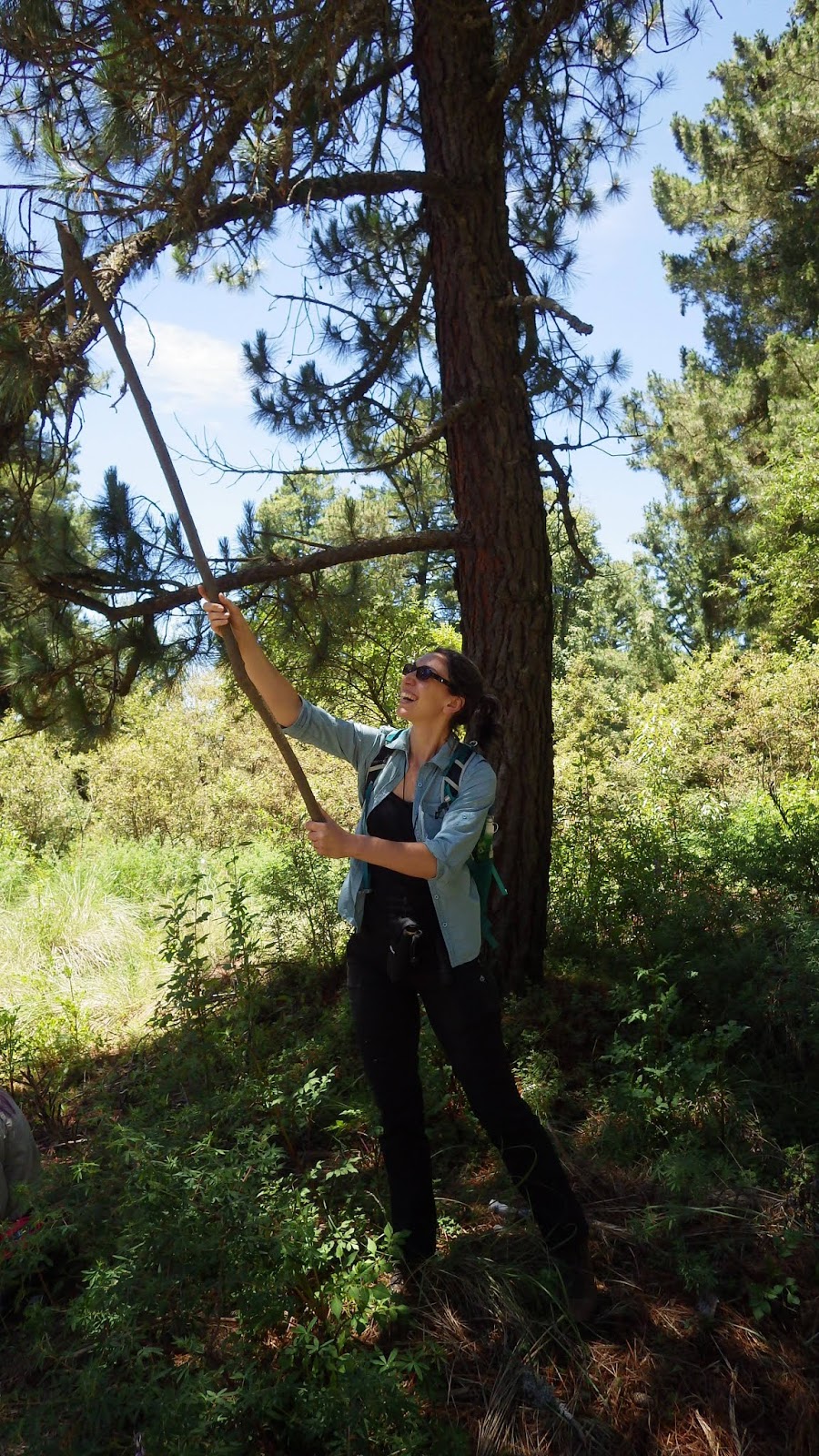
Sarah surveying pines
in central Mexico
Image: Markus Eichhorn
SP: Where to start? I’m an American who lived in England for 12 years and moved to Ireland last year. I’ve always been a nature-lover and have been fortunate enough to do field work in lots of different habitats around the world, looking at reptiles, birds, and mammals as well as plants. 

My interest in botany was sparked during my undergraduate studies in the US, but my botanical skills really improved when I did a PhD focusing on the effects of climate change on a grassland study system at Imperial College’s Silwood Park campus...

LM: Ooh sorry to interrupt but… Silwood Park? Did you study under Prof. Mick Crawley, the co-author (with Clive Stace) of the New Naturalist ‘Aliens’ book, the man behind the Daffodil Key, the Snowdrop Key…  ?

SP: Mick wasn't my supervisor, but I definitely asked for help with grass ID on more than one occasion! It was great to have someone so knowledgeable and approachable on hand.

Sarah leading an OPAL water survey
Image courtesy of Nature in Mind
LM: I’ll bet it was! And your PhD sounds really interesting too. So what did you do after that?

SP: Following my PhD, I worked as a Community Scientist on the Open Air Laboratories (OPAL) citizen science project at the University of Nottingham. That gave me the chance to help thousands of people get more engaged with nature and introduce them to simple methods of ecological recording. 

Then, last summer my son was born and my family moved to Ireland. I’ve spent the last year settling in and getting to know my new home.

LM: So you have experience of botanising in England and are now getting to know Ireland! 

I understand you’ll be splitting your time as Ireland Officer between Dublin and Cork? That will give you a chance to see lots of different plants!

Sarah on an Aquatic
Plant Project training day
Image: Edwina Cole
SP: That’s right. I’ll mostly be working from home in Cork but will be based at the National Botanic Gardens in Dublin a couple of days per month. 

I’ll also be travelling around Ireland when I can to join recording trips and other events. I’ve managed a few recording days in the south and midlands so far but will be looking to join events in other regions soon.

LM: So now you are BSBI’s Ireland Officer and I guess you’ve been thrown in at the deep end – if you’ll forgive the pun – as the Aquatic Plant Project is now well underway! I know Paul Green is at the helm but I imagine there’s quite a lot of work for you to do there?

SP:  Paul has done a great job getting the project off the ground in a really short amount of time! I’ve been helping on the administrative side of things, which has taken a fair amount of time, but I’m just excited to see that it’s been such a success!

Sarah at Cronohill with members of
the Cork local recording group
Image: Finbarr Wallace
LM: Are you finding time to get out in the field or is it office work all the way?

SP: It has been mostly office work so far, but I am trying to get out when I can. 

I managed to join the field meeting in Youghal in July, which was a lot of fun. In August, I met up with the Cork local group for a recording day at Cronohil and I had the chance to survey a beautiful site in Kerry for Hammarbya paludosa (Bog Orchid), which was a first for me. 

I also joined a couple of the Aquatic Plant Project days in the Midlands. 

It was wonderful to get involved after spending so much time on the organising side, and Nick Stewart is a great teacher!

LM: So what else is in your work programme for the next few months?

Sarah and recorders on 
an Aquatic Plant Project
training day
Image: Edwina Cole
SP: The next big thing is the Irish Autumn Meeting, scheduled for 21 September, which should be a really fantastic day and I’m hoping will give me a chance to meet a lot more of our Irish members and County Recorders

I’ll be doing what I can to support our County Recorders in the final push for Atlas 2020, and sorting out a few rare plant surveys too. I’m also looking to revamp the BSBI Ireland webpage, and of course keep on top of our social media accounts. There’s plenty to keep me busy!

LM: And people will be able to follow you on social media, whether on Twitter or on the BSBI Ireland Facebook pages.

SP: That’s right! I’m tweeting from @BSBI_Ireland, and the BSBI Ireland Facebook page, @IrishSectionBSBI, is updated by number of amazing volunteers as well as me.

LM: Well good luck, keep us posted on how you’re getting on and once again – welcome to the BSBI!

SP: Thank you very much! I’m very happy to be here!

Saturday, 31 August 2019

Rowan: in folklore and in Byron's Gin

Rowan: flowers, leaves and fruits
Image: J. Lyon
This month, rowan trees are coming into fruit across Britain and Ireland and both humans and birds are eyeing up those colourful berries! Rowan makes a delicious jelly (often eaten with game), and is also an important food source for birds during winter. But the value of this tree is not confined to the berries: the wood of the rowan tree is hard and heavy and was traditionally used for making wheels, in house-building, as oars, longbows and barrels for herring (the "silver darlings") which were an important food source in Scottish history.

Rowan was also important in folklore. Flora Celtica tells us that during a more superstitious past, hanging sprigs of rowan - on doors, on sailing boats and on cows' tails - was considered one of the most powerful ways of warding off evil and attracting good fortune. Conversely, cutting down a rowan tree was believed to bring bad luck.

According to C18th Scots author John Lightfoot, rowan berries were fermented and distilled to make a "very good" spirit; so it's hardly surprising that when Andy Amphlett, BSBI County Recorder for Banffshire, was working with Sandy Jamieson, Speyside Distillery manager, to choose ingredients for Byron's Gin, they selected rowan as one of those ingredients. 

This is probably a good time to remind you that if you buy a bottle of Byron's Gin to enjoy the delicious mix of ingredients, including rowan, you will also be helping to support the next generation of botanists, because - under the contract BSBI entered into with Speyside Distillery - for every bottle sold, a contribution is made to BSBI's Training programme. Slainte!  

Wednesday, 28 August 2019

West Galway: the main recording event for Irish botanists in 2019

Marsh St. John's wort & pipewort:
a common sight in Connemara
Image: J. Conaghan
I wonder if, like me, you were absolutely gutted to miss Ireland's main botanical event of the year? Last year's Mayo recording event was so amazing, I wish I could have gone to this year's 4-day event in Connemara/ West Galway. The Irish botanists are so friendly and helpful, and they always make botanists visiting from Britain feel really welcome! Not sure if the report below, by organiser John Conaghan (County Recorder for West Galway) is just making me feel more depressed that I missed this year's meeting! Next year for sure... Meanwhile, over to John:

"It has been a month since the end of the West Galway (H16) four day recording event, just enough time for the recording dust to settle. It all seems a bit hazy and frantic now. Meeting in the morning, driving to sites, recording, eating, sleeping, repeat…. essentially a botanical version of groundhog day. The meeting was very well attended with a total of 39 people appearing over the four days with anywhere between 16 and 27 people participating each day. In order to maximize coverage we divided into three groups each day, lead by myself, Robert Northridge and Rory Hodd. Although the final tally of records has not yet been compiled it is likely that somewhere in the region of 5500 records were made over the four days.

"The meeting was based in Clifden and the main aim was to increase the post-2000 species numbers in some of the less well recorded hectads in the western half of the vice-county.  As West Galway is a vice-county characterised by extensive areas of blanket bog, heath, bog lakes and coastal habitats visitors were delighted to see a number of species which occur in profusion such as Daboecia cantabrica (St. Daboeoc’s heath), Eriocaulon aquaticum (Pipewort) and Hypericum elodes (Marsh St. John’s wort). 

St. Dabeoc's heath in flower
Image: J. Conaghan
"During the meeting a range of sites were visited and the following account relates to groups in which I was involved. On Thursday we visited Omey Island which is accessible on foot across a sandflat at low tide. Botanical highlights on the island included an encounter with a very large and attractive colony of Eryngium maritimum (Sea holly) and a population of Sesleria caerulea (Blue moor-grass) on blown sand over rocks which turned out to be a new hectad record. On Friday we visited a delightful bog lake north of Carna village which yielded a fine collection of rarer wetland species including Rhynchospora fusca (Brown-beaked sedge), Eriophorum gracile (Slender cotton-grass), Eriocaulon aquaticum (Pipewort), Lobelia dortmanna (Water lobelia) and the very rare Deschampsia setacea (Bog hair-grass).

Investigating heathland west of Clifden
Image: J. Conaghan
"Saturday’s recording target was the lovely Derryclare Wood which is one of the few examples of native Oak woodland in Connemara. Thankfully it was relatively midge-free on the day, a very rare occurrence. In addition to the well-developed woodland flora the track into the woodland provided a good number of rarer non-native species including Mentha requienii (Corsican mint), Epilobium pedunculare (Rockery willowherb) and Juncus planifolius (Broad-leaved rush). The Irish distribution of these alien species is largely restricted to the Connemara region. On the final day a sand dune area at Eyrephort, north-west of Clifden, was visited. Notable species recorded here included Coeloglossum viride (Frog orchid), Asperula cynanchica (Squinancywort) and Trifolium medium (Zig-zag clover). 

"All in all the meeting was a great success and the feverish recording activity has greatly added to knowledge of plant distribution in West Galway. It was also great to meet up and hang out with a large number of people with a similar penchant for plant recording, something which doesn’t happen often enough".

Sigh... that sounds amazing! Keep your eyes peeled for details of next year's BSBI meetings across Britain & Ireland - we'll be posting them here in late November. 

Sunday, 25 August 2019

Introducing the Gatsby Plant Science Education Programme

Students identify different plants
during a practical session at the
Gatsby Plant Science Summer School
Image: Joe Higham 
We're delighted to present the first of three guest blogposts about the work of the Gatsby Plant Science Education Programme (GPSEP). 

Over to Emma from the GPSEP team to tell us more: 

"You’re probably familiar with the phenomenon of plant blindness, or ‘the inability to see or notice the plants in one’s own environment’ as it’s been defined. This results in reduced interest in plant conservation and the study of plant biology – which is a big problem, since we know how vitally important plants are for the environment and human health.

"The good news is that there’s a dedicated team working to solve this problem. The Gatsby Plant Science Education Programme (GPSEP) aims to strengthen plant science education in schools, colleges and universities, making a significant difference to the teaching and learning of plant science for students of all ages. Based jointly in the Sainsbury Laboratory at Cambridge University and the Cambridge University Botanic Garden, and funded by the Gatsby Charitable Foundation, GPSEP is a national programme across the whole of the UK –  impressive considering they’re a team of just 6 people!

"The programme is split into two sides. Working closely with schools, colleges and universities, the Science and Plants for Schools (SAPS) project advocates for presence of relevant and inspiring contemporary plant science in the school curriculum and develops teaching resources to support this. They support teaching from primary through to post-16, working with teachers and technicians, teacher trainers and trainee teachers. They also send out a half-termly newsletter to over 7000 subscribers.

The GPSEP team plus academic
advisor Celia Knight at the
Gatsby Plant Science Summer School
Image courtesy of
Gatsby Plant Science Education Programme
"One recent project SAPS have worked on is a MOOC (Massive Open Online Course) called Teaching Biology: Inspiring Students with Plant Science, hosted by online learning platform FutureLearn. This completely free course shows secondary biology teachers how they can use plants to teach practical science and engage their students.

"The Higher Education side of the programme seeks to nurture bright students in post-16 education with an interest in bioscience to become the next generation of leading plant science researchers. One important way they do this is through the Gatsby Plant Science Summer School. This is a unique opportunity for students studying at one of 28 universities across the UK to deepen their knowledge of plant science through talks from leading scientists, careers sessions, eye-opening practicals and thought-provoking discussions with researchers and peers.

SAPS Project Manager Alex Jenkin
gives an engaging talk to school
science teachers & technicians
 at the Association for
Science Education conference
Image: Joe Higham
"The Summer School has been running for 15 years with great success. Former students have gone on to study plant science further and pursue careers in the area. As one student put it, ‘The summer school has changed my perception of plant science in a positive way; having this opportunity has given me the insight I needed to find out where plant science can take me.’ We’d say that’s mission accomplished!

"But all of the above is just touching the surface of what GPSEP do. Across a series of blog posts over the new few months, we’ll be featuring a few of the exciting projects GPSEP are working on to increase awareness of plants, both in SAPs and Higher Education, so watch this space.

"Want to get in touch with the team with ideas, questions or thoughts? They’re always happy to hear from plant enthusiasts – you can find their contact details here".

Thanks to Emma for this introduction to GPSEP's work. It's worth mentioning here that BSBI and the Field Studies Council were so keen to support the excellent GPS Summer School that this year, we put together a useful flyer for participants, setting out resources from both organisations that could help people planing to work with plants. You can view or download a copy here.

Emma will be back next month to tell us a bit more about the MOOC - watch this space!