Thursday, 30 December 2021

British & Irish Botany: issue 3.4 published

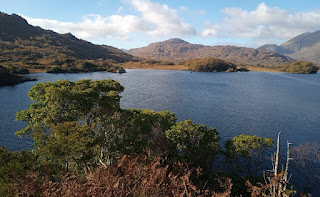
Strawberry Tree overhanging the water:
Upper Lake, Killarney, Co. Kerry
Image: R. Hodd 
We've just pressed 'publish' on the latest issue of British & Irish Botany, BSBI's online, Open Access scientific journal. This is the final issue of 2021 and features five papers - over to Editor-in-Chief Ian Denholm to tell us more.

"Several papers published previously in British & Irish Botany have helped to elucidate the origins of our flora through combining knowledge of present-day distributions with considerations of history and pre-history, and even folklore and mythology. Opening papers to the current issue apply such a multidisciplinary approach to two of the most iconic members of the British and Irish flora. 

"Strawberry Tree Arbutus unedo is one of the so-called ‘Lusitanian’ species occurring disjunctly in western Ireland and the Iberian Peninsula, and whose origins have been hotly debated. Micheline Sheehy Skeffington (BSBI’s new President-elect!) and Nick Scott present compelling evidence that Arbutus, in County Kerry at least, was introduced by copper miners arriving in Ireland in the late Neolithic. Coupled with Micheline’s other research on western Ireland specialities, this reinforces a likelihood that each of the Lusitanian species, far from having a homogeneous phytogeographical origin, has an idiosyncratic story to tell.
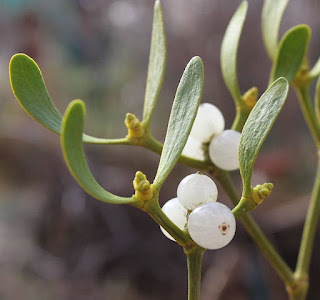
Mistletoe in fruit
Image: J. Briggs

"On a seasonal note, Jonathan Briggs reviews in detail the biology, range, uses and conservation status of mistletoe, Viscum album. As one of the leading world authorities on this species, Jonathan is well placed to attempt to disentangle occurrences that are native from one resulting from its widespread cultivation (to support its traditional role in Christmas festivities!). 

"Returning to an Irish theme, Dan Minchin and colleagues document the expansion of a colony of Water-soldier Stratiotes aloides on the shore of Lough Derg, County Galway. The colony was monitored over 13 years by surface observations supplemented by satellite images and a GPS-enabled drone – tasks that are complicated by most emergent plants descending below the surface during winter.

"Willowherbs Epilobium spp. are well known for their propensity to hybridise. BSBI expert plant referee Geoffrey Kitchener and colleagues report on new hybrid combinations for Britain involving a non-native, strikingly large-flowered subspecies of Square-stemmed Willowherb E. tetragonum subsp. tournefortii that is established on roadsides in Cambridgeshire and Bedfordshire. 

Tournefort's Willowherb on the right;
an intermediate hybrid on the left.
Image: P. Leonard 
"Hybrids between the native subspecies of E. tetragonum with other Epilobium taxa are very well documented, but those involving the newcomer subspecies are proving distinctive and noteworthy.

"In the final paper, Alastair Fitter and colleagues, including BSBI Head of Science Kevin Walker, detail the occurrence and ecology of the very local Gingerbread Sedge Carex elongata in Yorkshire, paying particular attention to a recent and substantial increase of this plant at Askham Bog near York. This expansion is not only welcome but also topical given that BSBI participated in a recent successful campaign to oppose a housing development in close proximity to the nature reserve".

So, another jam-packed issue with something for everyone. British & Irish Botany is free to read (and free for authors to publish in) and there's no log in required - just head over here to start enjoying the latest issue and then why not browse our archive? We are now accepting submissions for the first issue of volume four in 2022, so why not get in touch if you are thinking of contributing? Meanwhile, a very Happy New Year from all of us here at British & Irish Botany!


Friday, 17 December 2021

Around the World in 80 plants: discount offer for BSBI members

In the January 2021 issue of BSBI News, our membership newsletter, Clive Stace - BSBI's Book Reviews Editor and author of the New Flora of the British Isles - reviewed Around the World in 80 Trees by Jonathan Drori. 

Clive referred to "the excellence of the text and its major contribution to our appreciation and understanding of trees. Very highly recommended to all plant lovers".

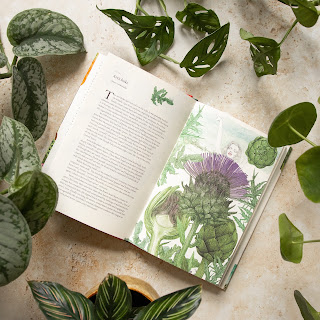
Now Jonathan Drori, a longstanding BSBI member, has published a follow-up book, Around the World in 80 Plants, which was short-listed recently for Waterstone's Book of the Year. 

Jonathan's publishers, Laurence King Publishing, said:

"In his follow-up to the bestselling Around the World in 80 Trees, Jonathan Drori takes another trip across the globe, bringing to life the science of plants by revealing how their worlds are intricately entwined with our own history, culture and folklore. 

"From the seemingly familiar tomato and dandelion to the eerie mandrake and Spanish ‘moss’ of Louisiana, each of these stories is full of surprises. Some have a troubling past, while others have ignited human creativity or enabled whole civilizations to flourish. 

"With a colourful cast of characters all brought to life by illustrator Lucille Clerc, this is a botanical journey of beauty and brilliance".

Lawrence King Publishing are offering a 35% discount to any BSBI members wishing to purchase a copy of Around the World in 80 Plants. If you are one of our c3,500 members, please visit the password-protected members-only area of the BSBI website and you will find instructions on how to claim your discount. Email me if you have forgotten your password. 

If you are not yet a BSBI member: claiming discounts on selected botany books is one of the many benefits of membership, so why not treat yourself? With our new online membership form and Direct Debit facilities (£ sterling or euros), it has never been quicker and easier to join our growing ranks and start enjoying all these benefits

Thursday, 16 December 2021

Blown away: December report from BSBI President Lynne Farrell

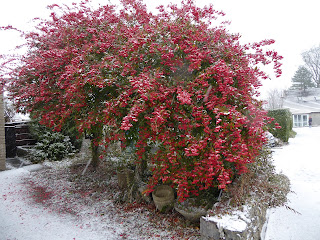
Cotoneaster full of berries - great for the birds!
All images on this page by L. Farrell
"The number of people attending the on-line meetings in late November has been very encouraging, and I would like to reiterate the vast amount of work that goes on behind the scenes to run these events, which we have all enjoyed. 

"Thanks go to our staff and volunteers. 

"If you were unable to attend, all the videos and exhibits from the Annual Exhibition Meeting and the Scottish Botanists’ Conference are available now, and you can find them by visiting the webpages and clicking on the links. 

"I hope that you have all survived the recent storms. Arwen reeked far more damage in the north-west than predicted and some villages in the Lakes are still without power. 

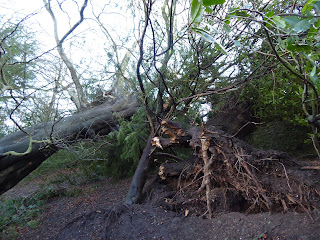
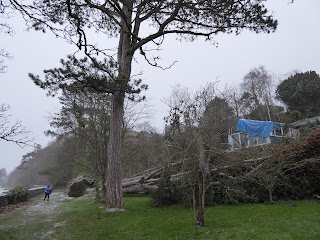
"Arnside did not have power cuts but many of the large specimen trees in the area have been flattened, partly due to the shallow roots on the limestone rocks and partly due to the unusual north-easterly direction of the wind whistling down the valleys. 

"The image on the left shows a large Beech which 'dominoed' an Oak and a heritage Pear Tree in a nearby local nature reserve. 

"Some neighbours had a lucky escape (see image below right) when the ancient Corsican pines were prostrated, although the tree with the raven’s nest remains standing. As I type this, Storm Barra is now making its attack and it remains to be seen what effect that has produced in the morning light.

"Owing to unreliable internet connections, I was unable to join the National Biodiversity Network's 2021 conference held recently but will be able to catch up with the recorded proceedings soon. It was an interesting programme, and I was a bit blown away myself as I was made an honorary member of the NBN Trust

"What else lies in store for us all before the end of the year? Small gatherings of families and friends over the festive period should go ahead this time, and I hope you all have a Happy Christmas. Please join in the New Year Plant Hunt from 1-4 January 2022 and let us hope we do not get totally blown away by it all".

Friday, 12 November 2021

Getting down to it: November report from BSBI President Lynne Farrell

November has been a time for getting down to it and it is a time to consolidate and enjoy what the Society has been doing throughout the year. 

On 6th November we held the Scottish Botanists' Conference by Zoom, and around 250 people tuned in, with many participating through talks, posters and photographs entered into the 2021 BSBI Photographic Competition

Videos of the talks will be available soon for those who missed this event on the actual day, but you can view the exhibits right now.

Next weekend, will be the Annual General Meeting on Friday 19th November in the evening, followed by the BSBI Annual Exhibition Meeting all day on Saturday 20th.

Again, this will be a virtual link, which in some ways is more flexible, enabling people from around Britain and Ireland (and overseas!) to join in, but it does involve much hard work behind the scenes, so thanks to our staff and volunteers for putting on the show, and thanks to our members for their contributions. 

I have been getting down to it in the field also, although I have to admit that is more challenging as I get older and certainly getting up from the ground is even harder (image below of me and fellow fungi-hunters lying on a cricket pitch to take photographs - taken by my friend Sue Brindle). 

However, there are some treasures to be found at ground level and with the generous amount of rain that has fallen during the past 3 weeks, many fungi have appeared very quickly, with different species emerging with each day. 

I am by no means a mycologist but that does not mean I cannot enjoy the sheer range and beauty of these ‘plants’ which have their own kingdom. Their names are equally as fascinating, including Orange Peel (image top right), Plums and Custard, Penny Bun, Violet Coral (image above left) and White Spindles. Please do leave these growing for others to see and enjoy, and just get down to fully appreciate them.


Wednesday, 20 October 2021

Season of mists and mellow fruitfulness: October report from BSBI President Lynne Farrell

The past month has consisted of many BSBI Zoom meetings- not my preferred activity but essential for keeping in touch with people in Ireland, Wales, Scotland and England, although I would obviously prefer to be able to meet at least some of you.

However, I have had a few visitors including friends and woodland ecologist George and Sue Peterken. George is writing a new book on Woodlands, so we were on Arnside Knott looking at the different forms of Juniper. This year seems to be a good year for berries (image on right). 

They gave me a copy of their book Art Meets Ecology, published in 2020, which aims to connect people who are happy to connect art with science- which certainly fits my interests. During a walk along the shore we found more black berries, this time definitely not edible, of Atropa belladonna, Deadly Nightshade (image below left).

Some trees have good crops of berries, with those on Rowan and Hawthorn being particularly abundant, whereas Oak and Beech have few fruits this year. The next day the bay was shrouded in mist and it took at least an hour to rise, so trying to capture the different phases meant sitting patiently for some time (image at the end of this blogpost).

Our coastline is very varied and always inspires me, and a short trip to St Abbs Head, Scottish Wildlife Trust reserve, and Marine Reserve, provided a stimulating walk, not only due to the stiff breeze but also for the excellent geology trail, fantastic scenery and the occasional rare plant of Crambe maritima. (image below right). 

A field of pumpkins nearby reminded me it’s time to make soup and chutney again!

Tuesday 12th October was Day of the Scientist, so I hope some of you enjoyed listening to the hour-long special edition of Jim Al-Khalili’s ‘ The Life Scientific’ on BBC Radio 4. There have been botanists on his programmes fairly recently.

Finally, I was very impressed with our new 'student membership' video which you can watch here. Congratulations to our volunteer Andrew Rowley who directed and produced the video, which is all about what student membership of the BSBI can do for you.. Excellent work Andrew. 


Monday, 4 October 2021

BSBI membership: we've just made it easier than ever to join us!

Small Scabious in Co. Durham
Image: BSBI member Heather Kelly 
In a rapidly changing world, our wild plants have never been more in need of the support, understanding and appreciation that BSBI is uniquely placed to provide. But we are entirely reliant on, and extremely grateful for, the contributions of our amazing volunteer members. If you haven't yet joined our growing ranks, then this is the best time of the year to do so. Read on to find out why...

First of all, it's great value for money! Join us in October for the year ahead and your membership starts at once, so you could enjoy up to 15 months of benefits for the price of 12 months, and no need to renew until January 2023. Our subscription rates are the same as last year, and with our newly-updated online membership form it has never been quicker and easier to become a member. 

Yellow water-lily in Warwickshire
Image: BSBI member Angelika Smith

So what do you get for your money?   

You'll become part of a diverse community of botanists, from national experts and specialists right through to plant-lovers who are just beginning to dip a toe into the world of identifying, recording and monitoring our wild flowers. You'll already have spotted some of the many free resources on our website but as a member, you'll be able to take the next steps to develop your skills. 

Looking for a short plant ID course? We can help you find one and you can apply for one of our grants to help with the cost. You don't have to be a BSBI member to apply for a grant but members are prioritised in the award process. We also have grants if you want to carry out more in-depth study or research. Find out more here.

Plant ID students
Image: BSBI Comms Officer Louise Marsh

Already studying plants? We have a package of support and opportunities tailored for students, and with our heavily-subsidised special student members' rate, you could end up paying as little as £1 per month! More info here

Interested in one of our series of Handbooks for tricky plant groups? We've published three Handbooks already this year and members enjoy some great discounts - 30% off the cost of our latest title, the Field Handbook to British and Irish Dandelions.

You'll be joining a society whose plant distribution data and analysis help policy-makers, conservation agencies, researchers and academics gain a better understanding of the changes happening right now to our wild plants and the urgent need to conserve important plant populations. 

Squinancywort in Co. Kerry
Image: BSBI member Jessica Hamilton 
In a time of biodiversity loss and climate change, the data gathered by BSBI's volunteer members and supporters have never been more important. 

Maybe you've taken part in one of our citizen science recording projects such as the New Year Plant Hunt, Plant Alert or the Garden Wildflower Hunt, or you've been out monitoring plants for the National Plant Monitoring Scheme, or been  recording in your local area

Or maybe you are just happy to know that your subscription is helping us to maintain one of the world's largest botanical databases (50 million records and counting!) and supporting our Science Team as they contribute to internationally important reports such as RBG Kew's State of the World's Plants and Fungi

Whether or not you are an active botanical recorder, by joining our growing ranks as a member you will be directly supporting our work to advance the understanding and appreciation of wild plants and support their conservation in Britain and Ireland. 

You'll be joining a community of people with a passion for plants, who share their knowledge and enthusiasm on social media; at our national conferences, workshops and field meetings; at local events organised by county flora groups; via our expert referee service (only available to members); and in our in-house periodicals such as our membership newsletter BSBI News which you'll receive three times a year. Here's a taster of what's in the latest issue and check out recent articles on wildflower ID books, on plant ID apps (how well do they work?) and how to ID those pesky dandelion lookalikes

Want more tips to get you started with plant ID? Check out these helpful hints

Keeled Garlic in Musselburgh
Image: BSBI member Chris Jeffree
To find out more about what our fabulous BSBI members - all 3,340 of them, a 7% increase compared to last October - achieved in the past year, why not take a look at our latest Annual Review

If you are already one of our members, we'd like to say a huge thank you to each and every one of you. If you haven't joined us yet, why not head over here and become member no. 3,341? 

With our new online membership form, it has never been quicker and easier to join BSBI and we can't wait to send you your bumper welcome pack! So if you share our vision of a world where wild plants thrive and are valued, right now is the time to join us.

Thursday, 16 September 2021

British & Irish Botany: issue 3.3 published

Snake's-head fritillary
Image: P. Stroh
We've just pressed 'publish' on the latest issue of British & Irish Botany, BSBI's online, Open Access scientific journal. 

This issue features ten papers, starting with a report by BSBI Head of Science Kevin Walker on the lovely Snake's-head Fritillary Fritillaria meleagris. Kevin's blogpost about this iconic plant, as part of our Wildflower of the Month series during lockdown, proved very popular and in this new paper he analyses its occurrence in different habitats and discusses its claim to native status. 

Next up we have a paper by Michael Braithwaite about the discovery of the local flora as reflected in BSBI vice-county datasets. Michael uses Berwickshire, where he was County Recorder for many years, as a case-study and his account makes fascinating reading for all botanical recorders in the run-up to publication in 2022 of our next plant distribution Atlas

Mayweeds on Orkney
Image: J. Crossley

Also in this issue we have a report on Sea Mayweed, Scentless Mayweed and their puzzling  intermediates in Orkney; and Mick Crawley considers the dramatic recent increase in abundance of Rat's-tail Fescue Vulpia myuros as a weed of winter wheat-fields - he reports on a long-term experiment at Silwood Park, Bucks. to discover what extent this increase is due to no-till cultivation, or to herbicide-resistance, or to autumn cultivation coupled with warmer winter weather.  

Authors of BSBI Handbooks have been busy too: Mark Lynes describes three new species of Lady's-mantle Alchemilla from northern Britain, ahead of publication, probably next year, of his long-awaited Alchemilla Handbook; and three new species of Dandelion are described by John Richards in the run-up to publication of his new Field Handbook to British and Irish Dandelions, due out next month. BSBI members should watch out for the special members-only discount offers on both these books.

Hepste Hawkweed
Image: T. Rich

Over to B&IB Editor-in-Chief Ian Denholm to tell us about the four remaining papers in this issue:

"Within the family Polygonaceae, Redshank Persicaria maculosa and Pale Persicaria P. lapathifolia are both common in Britain but subject to confusion through over-reliance on flower colour as a distinguishing feature. Michael Wilcox reviews contrasting taxonomic treatments and provides guidelines for rationalising considerable variation within the Pale Persicaria ‘complex’.

"Tim Rich continues his survey of the status of Britain’s Hawkweeds (genus Hieracium) with a report on Hepste Hawkweed H. apheles - an extremely rare endemic restricted to five plants in a single locality in the Brecon Beacons. This is one of several endemic taxa with a threat status of ‘critically endangered’ according to IUCN criteria, safeguarded to some extent by the deposition of seed in the Millennium Seed Bank.

"Finally, Clive Stace and Duilio Iamonico resolve issues of species typification within the genera Vulpia and Atriplex, respectively".

So, another jam-packed issue with something for everyone. British & Irish Botany is free to read (and free for authors to publish in) and there's no log in required - just head over here to start enjoying the latest issue and then why not browse our archive? We are now accepting submissions for the fourth and final issue of this third volume, due out in December - why not get in touch if you are thinking of contributing?