Friday, 15 July 2022

BSBI Summer Meeting 2022: the prequel

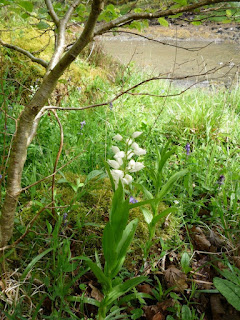
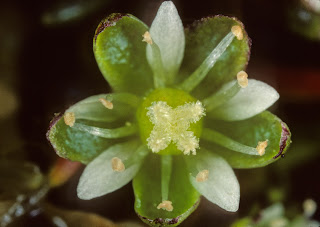
Round-leaved Sundew in Flintshire 14/7/2022
Image: J. Shanklin
Today the BSBI Annual Summer Meeting (ASM) starts at FSC Malham Tarn in the Yorkshire Dales. After two years of no ASM due to Covid, botanists are delighted to have a chance to meet up and enjoy four days of communal plant-hunting in lovely surroundings. BSBI Field Meetings Secretary Jonathan Shanklin has been leading on organising the event and he has recruited various attendees to write up daily summaries from the field, starting tomorrow, but today we bring you Jonathan's 'prequel' report, sent through late last night, after leaving his Cambridgeshire base and heading northwards and westwards towards some very different plants. 

Over to Jonathan:   

"Having done as much preparation for the ASM as I could and dealt with the morning's emails, I headed for the Clwydian hills to get in some practice on upland botany. I was targeting two species in particular that hadn’t been seen in the Flintshire part of the area for over 20 years and also doing some general recording. The two species were Drosera rotundifolia (Round-leaved Sundew) and Jasione montana (Sheep's-bit). The latter fell at the first hurdle, when the comment in the BSBI Distribution Database gave a description that the plant was on a forest road. Modern GIS mapping puts this in the neighbouring county of Denbighshire

Into the valley of sundews; Flintshire 14/7/2022
Image: J. Shanklin

"Having arrived on site, I climbed up and over the hills to the marshy area indicated on the map. No luck with the Drosera, but there was a good display of Lysimachia (Anagallis) tenella (Bog Pimpernel). Back up the hill and down the next valley, which was a lovely glacial u-shaped valley, with no trace of any water in the upper part. However towards the bottom I encountered a flush full of more Lysimachia and at the base, there was the Drosera. I had lunch here, then climbed back up to the hill-fort of Penycloddiau, where a lake was shown on the map. It was bone dry! I then headed north on a circuit for general recording. As water usually indicates a different flora in the uplands, I headed for the next stream and found some Narthecium ossifragum (Bog Asphodel), then Oreopteris limbosperma (Lemon-scented Fern) and finally Equisetum sylvaticum (Wood Horsetail), which are all rare plants in Flintshire. Most of the upland streams had plenty of Myosotis secunda (Creeping Forget-me-not), which might need to come off the Rare Plant Register

Sheep-s-bit in Flintshire 14/7/2022
Image: J. Shanklin

"I eventually completed the circuit and thought that as I had a little time left over I might as well try the forest road to see if I could find the Jasione. It clearly wasn’t where the approximate map reference indicated, but I thought I’d go on a bit to some gorse bushes and call it a day. Exactly at my turn-round point there was the Jasione! It turned out that Martyn Stead had seen it there in 2017, but a nice end to the day. 

"So the moral for the ASM – we’ll make some accidental interesting finds; we should keep hunting in likely habitat beyond the expected locations and we’ll have a great time looking".

Well said Jonathan - that's exactly the spirit needed by our intrepid botanists, boldly going wherever they think there might be some interesting plants to enjoy, to identify and then to record! Watch this space for more reports from the Summer Meeting.

Thursday, 14 July 2022

Scottish botanist raises extinction alarm on arctic-alpine plants

Snow pearlwort
Image: Sarah Watts
Scottish botanist Sarah Watts, PhD researcher from the University of Stirling, and a member of BSBI's Committee for Scotland, has been raising the alarm about the threat faced by rare arctic-alpine plants such as snow pearlwort, mountain sandwort and drooping saxifrage due to climate change. 

These species all require a cool climate at high altitude, so as the planet warms up, they have to move further northwards and upwards - until there is nowhere further for them to go. They also face competition from those lowland species colonising upland areas as they try to escape the effects of rising temperatures.

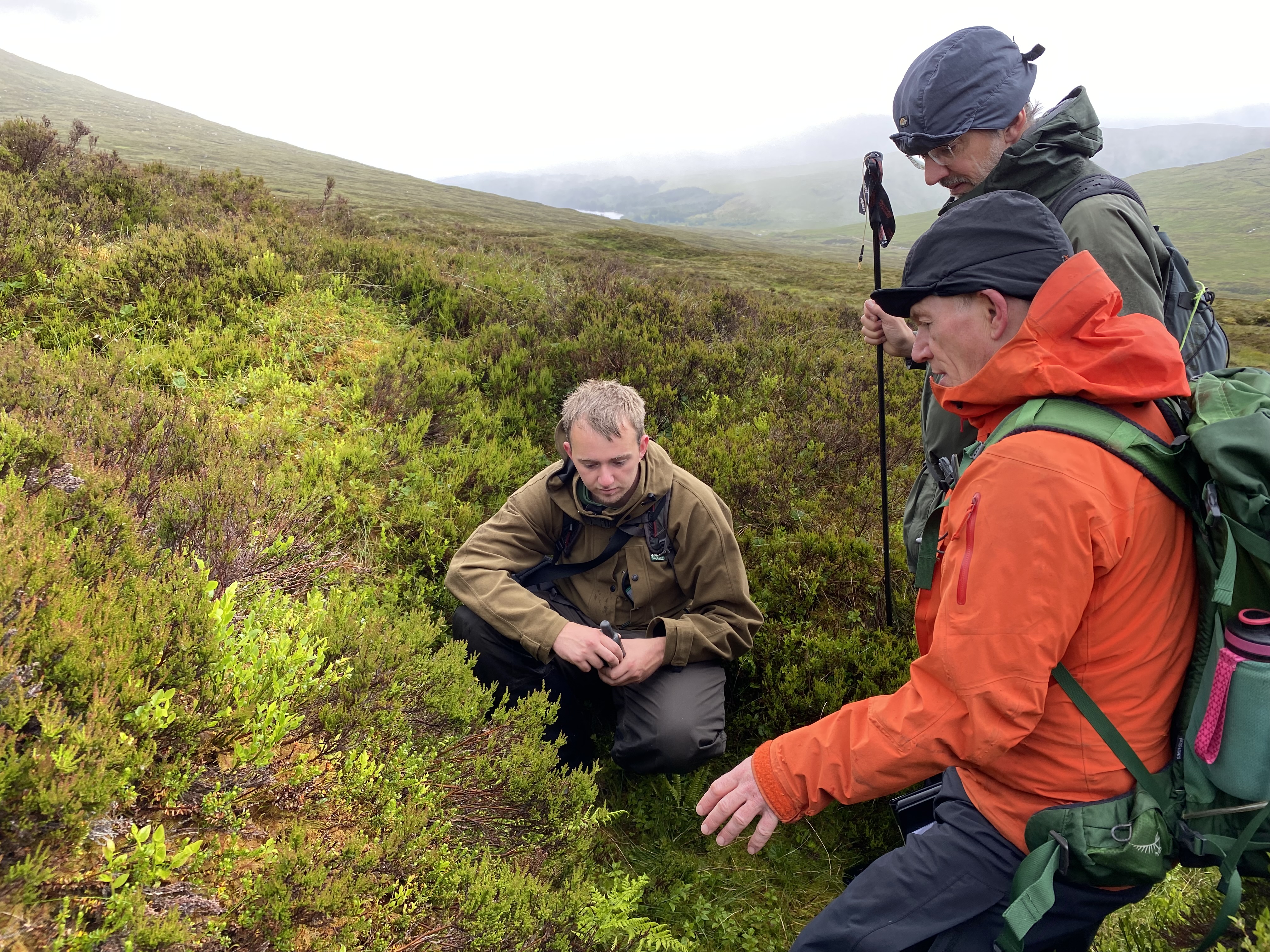
Sarah & Robin recording at Corrour, July 2022
Image Jim McIntosh 

Sarah's research is based on over 40 years' monitoring of the rare plants of Ben Lawers by staff and volunteers from the National Trust for Scotland. In a press release issued by Univ. Stirling, Sarah, who has spent the past twelve years as part of that team, said "Our research signals a rapid loss of biodiversity happening right now, which means that, if it's allowed to continue on this accelerated trajectory, due to climate change, we will see the extinction of species like these".

Sarah is co-author on this paper about snow pearlwort published in British & Irish Botany, BSBI's scientific journal; this plant has declined by 66% since the mid-1990s, leading the BSBI to change its conservation threat status from Vulnerable to Endangered. Snow pearlwort is the first vascular plant to be re-classified as Endangered due to climate change, but it's unlikely to be the last.

Botanists Gus, Robin & Jim (in red)
 recording at Corrour, July 2022
Image Sarah Watts
Jim McIntosh, BSBI's Scottish Officer, said: "This is a very worrying development; Sarah and I have just spent the past week with a team of botanists recording rare arctic-alpine plants on the Corrour Estate in the Scottish Highlands; we hope that this will set a good baseline for detecting any further changes due to global warming." 

To find out more about the plants that Jim, Sarah and the team recorded at Corrour, click on their Twitter accounts (this is Jim's and this is Sarah's) and on the #Corrour hashtag - and check out the coverage about Sarah's recent research into those rare arctic-alpines in news outlets such as the Daily Mail and the BBC website.  

Wednesday, 6 July 2022

Photos of aquatic plants sought for new ID book

Image courtesy of Inland Fisheries Ireland
Our colleagues at Inland Fisheries Ireland are putting together a photographic guide to Ireland's freshwater and riparian plants. The book will also feature BSBI distribution maps for the 300 or so species. You can find out more about the plans for the book in this video of a talk given at the Irish Spring Conference by lead author Ronan Matson. 

Ronan has just contacted us to say "We’re down to the final few species for our aquatic plant ID book and are looking for photos of the following plants if possible - your members and supporters might see them and be in a position to take photos over the course of the summer? We’re looking for photos that include in situ shots, flowers, leaves etc. anything that we might be able to use to create a profile for each species. We’d be happy to acknowledge anyone whose photos we use!"  

Here is the list of plants for which Ronan and his colleagues would like images: 

  • Rumex conglomeratus
  • Pontederia cordata
  • Carex paniculata
  • Carex aquatilis
  • Carex nigra
  • Carex lasiocarpa
  • Carex demissa
  • Carex flacca
  • Carex disticha

You can contact Ronan at Ronan.Matson@fisheriesireland.ie if you have any questions about the book or if you can help out with photos. Fingers crossed that some News & Views readers will be able to help!  

Thursday, 16 June 2022

Meeting up with fellow botanists - at last! June report by BSBI President Lynne Farrell

Last month saw BSBI President Lynne Farrell enjoying bluebells, orchids and bird's-eye primrose in Cumbria, where she is based. 

Then last week, at long last, our first face-to-face post-Covid national field meeting was held and Lynne was there to enjoy it. 

Over to Lynne to tell us more:  

"It has taken a long time, but it has now begun to warm up and, more importantly to me, I have been able to get out into the field and meet botanists again. 

The Wales Annual Meeting and AGM, held at Bangor, Caernarvonshire from 10th to 12th June, had a good attendance, and it was a delight to be able to share plants and visit places with others. 

"We explored a variety of habitats from botanic gardens, to mountains, saltmarsh, dunes, meadows and wet patches.  

"Treborth Botanic Garden, situated on the coast near the Menai Bridge, is being restored by a group of enthusiastic people following on from the retirement of Nigel Brown, who cared for the Garden for many years and who is now continuing to enjoy life as joint BSBI County Recorder for Anglesey.

"The images this month are from a recent coastal visit in Cumbria, where some species such as Sea Bindweed Calystegia soldnalella (image above right), are easy to identify but we needed to get down on our hands and knees with the books (image above left) to be sure of Variegated Horsetail Equisetum variegatumFortunately, we had Mike Porter, co-author of the BSBI Handbook on Violas, with us to pronounce on the coastal ecotype of Wild Pansy Viola tricolor coastal ecotype (image below).


Thursday, 9 June 2022

British & Irish Botany: issue 4.2 published

Sword-leaved Helleborine
growing under oak and holly
 in Knapdale, Argyll
Image: P. Batty
 

The latest issue of British & Irish Botany has just been published and features nine papers or short notes which range across time and space to grab your botanical attention, whether your interest lies in trees or grasses, gorgeous orchids or challenging apomicts!

There are two papers for orchid-lovers, investigating long-term changes in their abundance and distribution, so it seems fitting to ask Editor-in-Chief Prof. Ian Denholm to say something about them, as he is also one of our expert referees on orchids

Over to Ian: 

"Dave Trudgill follows up on his paper in our last issue, once again using data extracted from BSBI’s Distribution Database, but this time he is comparing the current ranges in Britain of 20 orchid species with those recorded four decades previously. Emphasis on northern and southern geographical limits provides insights into likely impacts of climate change on the distributions of individual taxa. In our second orchid paper, Patricia Batty reports on systematic monitoring of four Scottish colonies of Sword-leaved Helleborine, Cephalanthera longifolia, following the size, flowering success and longevity of individual plants over a 22-year period". 

Birches at Holme Fen
Image: S. McAdam

From Scotland to Holme Fen, Cambridgeshire, for our next paper, but staying with the theme of long-term observation, Anthony Davy and John Gill report on growth trajectories of a stand of birch trees over a 38-year period; then we stay with trees but head over to Wales, where Martin Lepsi and Tim Rich focus on two endemic Welsh whitebeams, Sorbus cambrensis and S. stenophylla

Next we go back in time, for a report by Jim Bevan on the 16 species of hawkweed Hieracium that were known in 1821 and the nomenclatural problems which still exist.

Brambles are as tricky to identify as hawkweeds and it doesn't help when they change their names, but the new name proposed by Muhammad Idrees and Julian Shaw for the species formerly known as the Rubus rubicundiflorus is both snappier and honours a much-loved botanist, the late Peter Sell

This issue also features notes on Atriplex species and hybrids by Mike Wilcox; a conspectus of, and key to, the world's species of Vulpia by Clive Stace; and a discussion by Diulio Iamonico on the typification of the Linnean name Papaver medium in Flora Anglica (1754). 

We hope that you enjoy your whistle-stop tour across the decades and countries with this latest issue of British & Irish Botany, which as always is completely free, both for you to read and for our authors to publish in: happy reading! 

Wednesday, 8 June 2022

Botanical heatmaps will ensure 'Right Tree, Right Place' - thanks to BSBI's volunteer recorders

BSBI volunteer recorders identifying
 and recording the plants they spot
Image: M.Crittenden
At BSBI, we are sometimes asked - by those who are new to the Society and our work - how exactly the botanical records that our volunteer members collect help us to fulfil our goal of addressing biodiversity loss and climate change (one of the three goals in our strategic plan). Well, today we can tell you more about one recent initiative which uses the plant records in the BSBI Database to help protect both our wildlife and the sites on which we rely for carbon sequestration. 

This initiative - botanical heatmaps - has been developed by BSBI in partnership Natural England, and I asked BSBI Head of Science Kevin Walker to tell us more.    

LM: So Kevin, what exactly is a botanical value map/ heatmap?

BSBI's Kevin Walker recording sedges
Image: P. Stroh
KW: “The ‘heatmaps’ are basically coincidence maps that summarise of all the amazing botanical records that BSBI volunteers collect. In the case of the tree-planting maps, these summarise the coincidence of rare, scarce, threatened species as well as habitat specialists that indicate the presence of good quality habitat on the ground. 

"We have produced a number of maps for the ‘Right Tree, Right Place work’: maps for rare, scarce and threatened species at 100 x 100 m resolution, habitat indicators at 1 x 1 km resolution and an overall ‘botanical value’ map which combines all these datasets”.

LM: What should a landowner do if they are thinking of planting trees on their land and want to make sure they are going to end up with the right tree in the right place?

Tree-planting was due to take place on this
 species-rich peatbog in Cumbria, which
 supports sundews and cranberry
Image: K. Watson  
KW: “These maps will help landowners to see if their land is likely to have open habitats of interest that should not be planted on. These might include species-rich grassland or blanket bog with deep peat. From July the ‘botanical value’ maps will be free to access online – these will indicate if the 1-km within which a planting site is located has species of conservation interest. The more detailed data-layers will be available to organisations that are likely to be involved in planting proposals such as Woodland Trust and Forestry Commission”.

LM: How did the idea for the heatmaps come about?

Botanical heatmap showing
priority plant species
(yellow = high priority)
 
KW: “The UK government’s ambitious tree-planting targets have unfortunately led to some planting of trees on open habitats rich in wildlife and/or important for carbon sequestration. In some cases, it was apparent that BSBI held data which could have been used to avoid such damage and so we worked closely with Natural England and the Woodland Trust to see how these data could be most effectively used. 

"The heatmaps are the product of this work and have taken about 18 months to produce, working in partnership with colleagues in Natural England, the Woodland Trust and the Forestry Commission. The most recent development has been funded by Defra, through the Natural Capital and Ecosystem Assessment (NCEA) programme".

LM: As you mentioned before, the data underpinning the heatmaps comprises all the plant records that have been collected over the years by our wonderful BSBI volunteer recorders. How many records are currently held in the BSBI database? 

KW: "As of today, the BSBI database contains a staggering 50,688,285 records, mainly collected by our amazing volunteer recorders, who go out in all weathers across Britain and Ireland and submit their records to the BSBI Distribution Database. In recent years this total has been augmented by about a million more records each year, and all these records are being increasingly used for nature conservation and scientific research".

Aspens silhouetted against the skyline:
the right tree in the right place!
Image: P. Smith
 
LM: That's impressive Kevin, and three cheers for all our wonderful volunteer recorders. Final question, if BSBI members and supporters want to find out more about the heatmaps, where should they look? 

KW: "We produced a great summary in our membership newsletter, BSBI News – and we've made the article freely available here so non-members can read it too. On the Natural England website, there's also a technical report and a blogpost about the heatmaps". 

LM: Thanks Kevin, readers can download a copy of the technical report by following the link on this page

Many thanks to Kevin for telling us about the botanical heatmaps and for all the hard work that he and our partners at Natural England, the Woodland Trust and the Forestry Commission have put in over the past 18 months to launch this exciting new initiative. And of course, thanks again to our fabulous volunteer recorders, without whom those botanical heatmaps would be completely empty! 

Finally, a call-out to any readers who haven't yet tried botanical recording but are inspired by hearing about the botanical heatmaps - there's lots of help and support on offer if you want to get involved: Check out these helpful hints to get you started, these resources to help you identify the wildflowers you spot and then try using the form on this page to submit your first ever plant record. 

Monday, 6 June 2022

BSBI Finance Manager running to support members in hardship

In the last couple of years, we've heard from several long-term BSBI members experiencing financial difficulties; we put our heads together to find a way to help them and we've created the BSBI Hardship Fund. One of our staff members, BSBI Finance Manager Julie Etherington (that's her on the right) is so keen to support the Hardship Fund that she is preparing to go the extra mile - in fact the extra 21 km. - to raise money towards the Fund. 

I caught up with Julie to find out more but first of all, over to BSBI Fundraising Manager Sarah Woods to tell us how the Hardship Fund idea came about:

Sarah: "The Hardship Fund has come around thanks to a number of groups and individuals at BSBI (including Julie herself) and an overarching belief that short-term financial issues should not mean people are excluded from something they care about – particularly where they might have been part of the fabric of BSBI for years. I think it is a principle that many will agree with, and for many years much has been done to try and keep all members connected with the Society, regardless of circumstances, but the time was right to formalise this slightly more into what has become the Hardship Fund".

Louise: What impact has the Hardship Fund had so far, and have many people benefited? 

Sarah: "I’m happy to say that we’ve been able to approach a number of individuals who’d let us know that they had had to consider their membership in 2022 for exactly the reasons the Fund was created, and we’ve been able to help them bridge the cost of membership and remain with the Society. Given the wider economic picture at the moment, it feels necessary and right that we have been able to put this in place, especially given the contribution so many members give to the life of the Society through volunteering, recording and engaging with our work".

Louise: Our members certainly make amazing contributions to botanical recording and scientific understanding, so anything we can do to support them gets my vote! 

Now, over to you Julie: How long have you been running and have you ever attempted a half-marathon before? 

Julie: "I’ve always been an on / off runner, however, in 2019, I took it up with much more interest in a bid to get fit before turning 50. To me, running is not only to get fit but but now also an opportunity to free my mind for an hour or two, to relax, have fun and a great excuse to get outdoors. I normally don’t take it too seriously & choose not to check times or distances so I surprised myself by spontaneously entering a 10k race in my village in September last year. I loved the buzz of the event so when my running buddy Kate suggested doing a half marathon, the seed had already been planted to believe I could go further … and here I am, running my very first half marathon".

Louise: Wow, so you're really starting to get serious about your running! But have you ever done any kind of sponsored run before? 

Julie: "Although I’ve raised money running before, such as for the well-known Cancer Research Race For Life, I know that smaller charities can sometimes get overlooked so this time seemed the perfect opportunity to support a new and important cause close to my heart - BSBI’s Hardship Fund". 

Louise: We're really glad that you are supporting the Fund, both with this half marathon and by championing the idea over the past few years. And I see that you've had a lovely BSBI T-shirt printed (image above right) to wear on the day! So, what have you been doing to get in training?

Julie: "All sorts of things! Every Monday for the last couple of months, Kate tells me how far we need to run in the week ahead; now in excess of 30km per week. Unfortunately, I have very little discipline when it comes to following a training plan so I tend to instead make it up as I go along. Last month, for example, I did a HIIT session, yoga, ran a little and climbed Helvellyn over Striding Edge (image above left) with a friend on a rare and gloriously blue Lake District day; a perfect & memorable experience".

Louise: That sounds intense! So once the run is over and all the donations have been collected and gone into the Hardship Fund, how will you be relaxing? 

Julie: "Straight after the race - which is on Father’s Day, Sunday 19th June - probably one of the first things I’ll do is to phone my lovely Dad to give him the news of whether I made it over the finish line. He’s given me special dispensation to miss visiting him on Father’s Day this year so I will definitely want to talk to him instead.

Longer term, I will definitely continue to run. I feel very lucky to live in a lovely part of West Lancashire where there are so many quiet lanes, hills and beautiful views to enjoy. Whether I do another half marathon after this remains to be seen, though I suspect I have "the bug" now!" 

Louise: Good luck Julie! If anybody would like to sponsor Julie and help support the BSBI Hardship Fund, here is Julie's Just Giving page. Keep an eye on this page to find out how she got on and how much money was raised for the Fund. And if you are a BSBI member experiencing financial difficulties, take a look at the Hardship Fund webpage where you can find out about the criteria and how to apply.

July update: Julie completed the half marathon and at the final count she had managed to raise more than £1250 for the Hardship Fund - amazing work, Julie!