Friday, 15 May 2015

Botanical find of the year? Hebridean recording Part 3

Mibora minima on North Uist
I promised you news of an exciting discovery from this year's Hebridean recording extravaganza and the photos have now come in. 

While out with VC Recorder Paul Smith last week, sharp-eyed Oli Pescott spotted a species which is apparently new for Scotland as a native "wild plant" although it is known as an introduction. 

The team has since been back to take photographs and count how many individuals are in the population. Over to Paul:

"As promised, here are some pictures of our find of the week: Early sand-grass Mibora minima, which is new for Scotland. Around 1,000 plants in quite specific habitat on dunes in the machair, many of them very tiny (about half the height of a 5p coin). 

"It is reputedly the smallest grass in the world (I'm borrowing Stephen Bungard's phrase here - he has also posted about the discovery of Mibora minima on his Skye & Raasay blog). The image on the left shows Stephen in surveying mode. 

Apparently Mibora minima isn't new for Scotland, where it has been known as an introduction in East Lothian (VC82). [Take a look at this map on the BSBI database, showing where this plant grows and how little there is of it in UK]. "But this is probably the first native locality, and a big range extension. I'll write it up in more detail for BSBI News in due course."

We'll all look forward to reading more about this find of the week (of the year, surely?) in the next issue of BSBI News. The image on the right - which I suspect will also appear in BSBI News - shows how tiny the plant is, so Oli deserves a huge round of applause for spotting it!

In the meantime, another of the Hebridean recording team has sent me an account of his week on North Uist, contrasting it with his home county in the English Midlands where he is VC Recorder. 

Watch this space!

Thursday, 14 May 2015

Botanical snippets for May

1. Lots of botanists are gearing up for Monday's international 'Fascination of Plants Day'. Dr M is running this event at University of Reading, in Oxford there is an event at Harcourt Arboretum and in Liverpool, the World Museum, University of Liverpool and Ness Gardens are joining forces to put on this event. Find out more about events around the country for FoPD here.

2. Cambridge Botanic Garden is also holding its third annual Festival of Plants on Saturday, again under the FoPD banner.

3. Thanks to Kath Pryce for spotting the letter (above right) in Country Life magazine. A reader enquires if her collections of pressed wildflowers from the 1950s could be put to any use today. I wonder if Country Life would like to run an article on herbaria


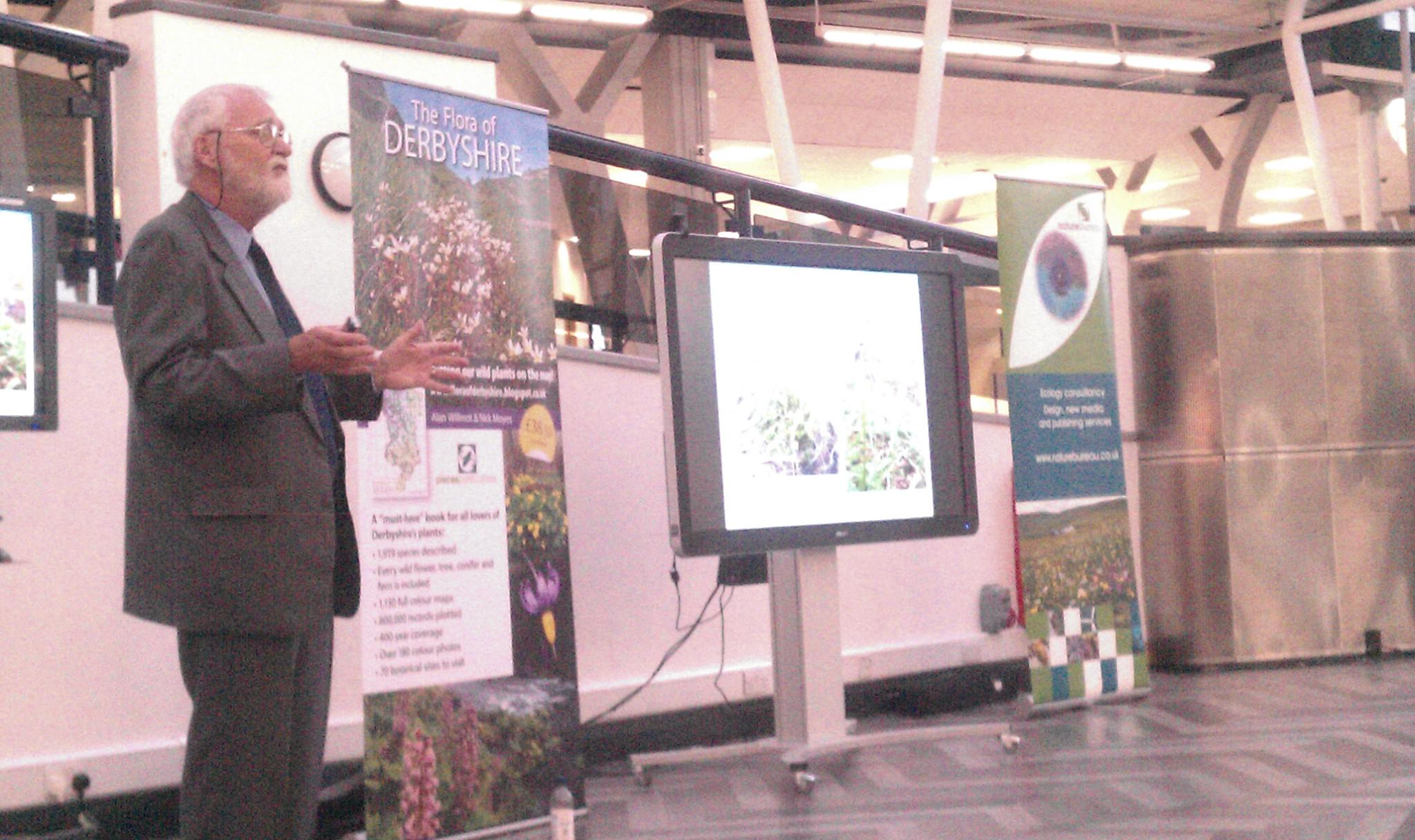
Embedded image permalink4. The new Flora of Derbyshire has just been launched to great fanfare. Many congratulations to authors Alan Willmot, BSBI Recorder for Derbyshire (VC57), and to Nick Moyes. The image on the left shows Dr Willmot at the launch earlier this evening.

5. And finally, a BSBI member who is selling her 15 acre smallholding in Aberdeenshire has been in touch. She tells us she has planted many wildflowers on the site such as Scottish primrose, trees including junipers and old varieties of apple, and has created wildlife habitats. She is only selling up due to ill-health and hopes that a plant-lover may be interested in buying the property and keeping the gardens going.  If interested, email me and I can put you in touch with the owner so you can find out more.  

Wednesday, 13 May 2015

Outer Hebrides Recording Extravaganza 2015: Part Two

Alison and Oli looking for Erophila
More reports coming in from Paul Smith and his merry band of botanists on North Uist. The other day they were up a hill looking at Wild Garlic and now they are exploring a different and distinctively Hebridean habitat, the machair.  

Paul says "We've spent a few days on the sand dunes looking at little annuals on the machair, including Erophila and Saxifraga tridactylites

Cerastium semidecandrum
"Oli [Pescott] has also been doing a start turn finding things, and has turned up good believable Cerastium semidecandrum, a bit doubtfully known from vc110 beforehand."

Oli has been working so hard as one of the key players behind the new National Plant Monitoring Scheme, so it's great to hear that he's getting a bit of a break away from his computer and his day job at CEH. It's always good to get out in the field! 

Paul has also tipped me off about a really exciting discovery made by Oli, so I'll be posting that in a few days, along with pictures. Watch this space! 

Trying very hard not to be jealous about the lovely scenery they are seeing while botanising...


Paul photographing Cerastium semidecandrum

Monday, 11 May 2015

Outer Hebrides Recording Extravaganza 2015: Part One

This year's recording has already started on North Uist, with Paul Smith (VC Recorder for the Outer Hebrides and also Chair of Records & Research Committee) and his trusty team of botanists hard at work a little earlier than in previous years

They have already enjoyed the usual Hebridean mixture of glorious sunshine and horizontal rain -  which, in the Western Isles, often occur on the same day! 

Paul said "We've been busy with Taraxacum (following on from the impetus of John Richards' Hampshire Taraxacum weekend, which was great) - the photo on the right shows Oli [Pescott] and me processing the day's catch (which takes significant effort in the evenings). 

"There are lots of section Erythrosperma on the sand dunes which look rather pretty, as well as some rather chunky species close to habitation. But they're in pretty good condition at this end of the country (although they are all over in Hampshire now).

"We also had a trip to Eaval, the biggest hill on North Uist (but not very big - only 347m), refinding some of the old records for Salix herbacea (on the summit) and Allium ursinum (on the north side below the cliffs). Allium ursinum is uncommon in vc110, and has a funny distribution - this population is an outlier from others in the Uists. But there are still some old records that need refinding for Eaval."

The pic on the left shows Paul on Eaval with Allium ursinum and if you click here you can see its distribution map. Click here to see the map for Salix herbacea.

Saturday, 9 May 2015

Patterns of Flora on Raasay, off the Isle of Skye

Pyrola rotundifolia
Image: S. Bungard
Many thanks to Dr Stephen Bungard, County Recorder for North Ebudes (that's the Isle of Skye to most of us!) He has been in touch to tell us about a project he is involved in which brings together art and botany on the lovely island of Raasay off the east coast of Skye. Raasay is home to Gaelic poet Sorley MacLean who can be heard here reciting his poem 'Hallaig' set to music by Martyn Bennett. The video includes images from the Isle of Raasay. 

The project is organised by ATLAS Arts, and is called Patterns of Flora: Mapping Seven Raasay Habitats. It is being launched with a weekend of activities taking place during the weekend of 6th - 7th June. Stephen collaborated with organisers to identify the seven habitats and will also be offering guided botanical walks during the weekend. The project also features the work of ceramicist Frances Priest.


Ophioglossum azoricum
Image: S. Bungard
More details about the project can be found here, Stephen's website is here, his blog about the plants he sees on Skye, Raasay and the Small Isles is here, and you can see Stephen's Flora of Raasay and Rona here

For images and more information on the plants of Skye, Carl Farmer's website is here and this blog by BSBI Treasurer Terry Swainbank focuses on the wildlife he sees on his croft on Skye.  

Friday, 8 May 2015

Watercolours and photographs of wildflowers

Viper's Bugloss at Burham, Kent
Image: D. Steere
Paintings and photos of plants can be very helpful for botanists keen to improve their ID skills, as well as being beautiful in their own right. So, many thanks to both Cambridge botanist Monica Frisch, who sent the details below about an art exhibition in Cambridge, and also to Kent-based wildlife enthusiast and amateur photographer David Steere, whose images can be seen both on Twitter and on his wildlife blog. He kindly provided the images of Viper's Bugloss which grace this page. 

Monica said "A wonderful exhibition of botanical art has just opened at Clare Hall in Cambridge, with a focus on the special plants of the Breckland. As botanists know, the Breckland, an area of dry sandy heath in East Anglia, is one of the richest botanical hotspots in the UK with an assemblage of specialist plants not found elsewhere in the UK. 

Echium vulgare var, albiflora from Dungeness, Kent
Image: D. Steere
"Many are very tiny and easily overlooked, while others may be larger but very rare. A group of East Anglian artists have been working for the past three years to paint the wild flowers of the Breckland. Some of their paintings are now on display at Clare Hall until 24th June 2015.

"Most are watercolours, of great beauty and accuracy, showing the details of the plants, such as the hairs on Viper's Bugloss or the individual flowers of Military Orchid. 

"The advantage of paintings over photographs is that all the extraneous clutter of leaves, grass and other plants can be omitted, allowing the individual plant to stand out and be admired in all its glory. 

Viper's Bugloss from Larch Wood, Detling, Kent
Image: D. Steere
"While the paintings of the Breckland plants are not for sale, because it is hoped that the collection will be published, the exhibition also contains many other equally attractive botanical paintings. 

"At the opening on 7th May, John Parker, former Director of Cambridge Botanic Garden, gave a brief introduction to the Breckland and explained how valuable high quality botanical art is to the scientific understanding of plants. 

"Brief botanical notes accompany all the pictures. If you are anywhere near Cambridge it is well worth visiting. The Clare Hall Gallery is open daily from 9am to 6pm and the Iceni Botanical Artists exhibition is on until 24th June 2015".

Thanks again to Monica and to David. If you know of any exhibitions of botanical art, whether paintings or photographs, please email me at louise.marsh@bsbi.org so I can share them here. 

Wednesday, 6 May 2015

New resource for heathland managers

Boldrewood Heath, New Forest
Image: C. Chatters
Martin Rand, VC Recorder for South Hampshire, has been in touch to tell us about a new resource which he describes a "terrific piece of work" which will "strike a chord with many BSBI members". 

The work in question is a report called 'Our Heaths: a summary of the evidence which informs the management of heathlands for wildlife' and you can download it free of charge from the website of Hampshire & Isle of Wight Wildlife Trust here.

Pilularia globulifera
Image: C. Chatters
The author is Clive Chatters, Head of Conservation (Policy and Evidence) at the Trust. Clive told me "the purpose of this report is to meet the needs of those who want to have a deeper understanding of why we manage heaths, particularly why we graze them". 

Crab Tree Bog, New Forest
Image: C. Chatters
As the report points out, species such as Pilularia globulifera require well-illuminated, bare open heathland habitats and if these scrub over, the species will be negatively impacted. That's why grazing (at the right pressure and at the right times) is so important.

A quick look through shows that the names Pearman and Rackham and Rose are cited and the references, which extend over 7 pages, show that this is a serious piece of work, hence Martin's enthusiasm. Nicely written too - there is a great quote from Francis Rose in there, on the subject of grazing: "The JCB is this interglacial's woolly mammoth" and Clive notes Rose's influence on the Trust's management of heathlands.

If you are actively involved in heathland management, why not take a look at the report and leave a comment below, letting us know what you think?