Wednesday, 25 September 2019

Grassland plants of the British & Irish lowlands: interview with co-author Pete Stroh

There’s a major new BSBI publication in the offing. Grassland plants of the British and Irish lowlands: ecology, threats and management will be published this autumn and BSBI members are able to benefit from an exclusive offer which will save them £10 compared with the RRP of £35.

There are six authors behind the new book: Pete Stroh and Kevin Walker from BSBI; Stuart Smith from Natural Resources Wales (NRW); Richard Jefferson and Clare Pinches from Natural England; and Tim Blackstock, ex-NRW and now honorary lecturer at Bangor University. I spoke to lead author Pete Stroh and asked him to tell us a bit more about ‘Grassland plants’.

LM: Pete, the new book is just over 400 pages long and covers 109 species considered to be of greatest conservation concern in the lowlands. How long have you and colleagues been working on the book and how did you select which plants to look at?

Globeflower
Image: Bob Gibbons
PS: Well, it all began long before I was working for the BSBI, so it’s at least seven years in the making. The original team, which included Stuart, Kevin, Richard and Tim, but also Carrie Rimes (NRW) and Chris Preston (ex-Centre for Ecology & Hydrology), got the ball rolling about 10 years ago, following the publication of the GB Red List. The Red List was able to compare two Atlas periods, and one of the main findings to come out of the analyses was the number of ‘widespread decliners’ - species that we imagined were doing OK, but actually were not faring at all well, such as Field Gentian. 

Many of these widespread decliners are featured in the Grassland plants book, and we also included some that were assessed as being of ‘Least Concern’ in the Red List, such as Moonwort or Bog Pimpernel, because they were known to have undergone considerable declines in the lowland parts of their range. Although lots is known about conservation management and restoration of lowland grassland in Britain, there isn’t much published information on the management requirements of individual grassland species. 

The main objective of this book was to assemble in one place all the relevant grey and peer-reviewed literature for our most threatened lowland grassland species so that they might be conserved more effectively in the future. I must also mention that although there are six authors, BSBI members indirectly contributed massively via the plant records they have sent in over the years, and many County Recorders and BSBI expert plant referees either co-authored or made a valuable contribution to individual accounts.

Miltary orchid
Image: Leif Bersweden
LM: Each species account gives a huge amount of detail: identification, typical habitat, biogeography, ecology, known and potential threats, and management requirements, all illustrated with colour images and BSBI distribution maps. Could you give us an example of one of the plants you focus on and what we might learn about it from reading the book?

PS: Gosh, that’s a difficult one! I’m not sure I can pick just one. The species we write about are so varied – orchids, sedges, cat’s-ears, cudweeds, etc.! I hope that many will find the tips for differentiating similar-looking species useful. They combine loads of different sources, as well as tapping in to personal experience. 

The sections on ecology were probably the most challenging to write, as we’ve tried to incorporate all that is known about a species using grey and peer-reviewed literature, meaning you should not have to trawl through loads of reference books and obscure journals in order to know its most important pollinators, or the longevity of seed in the soil, if it’s a larval foodplant for any rare invertebrates, or how it is dispersed. 

You can learn about where a species grows, what it grows with, and most importantly, we feel, read tips on how to ensure that it persists and thrives at a site.

Mountain pansy
Image: Laurie Campbell
LM: It sounds as though the book will be extremely useful to a wide range of people, from land managers to professional ecologists and consultants, to anybody with an interest in, or responsibility for, the care and conservation of our wild flowers.

PS: Yes, I hope so! I see it as a reference book that will actually be useful and read! It condenses a huge amount of information into what are essentially over 100 ‘mini biological floras’ which are, I hope, readable and practical, and are as much use to someone who has one or more of the plants on their land and wants to know more about them, to an academic, to a restoration ecologist. There’s something there for everyone!

LM: I see that there is a foreword by George Peterken – can you give us a taste of what he says?

Bog pimpernel
Image: Pete Stroh
PS: Well, as many will know, George is a bit of a legend in the conservation world, known originally for his work on woodland ecology, but he’s also an expert on meadows too, and many other things beside. So it was great for him to agree to write the foreword. 

It’s kind of difficult to distil what he says into a few sentences, but in essence, he makes the point that although it appears to be superficially simple to create a floriferous meadow, in many cases ancient grassland is as impossible to recreate as ancient woodland, and so keeping and maintaining existing herb-rich grasslands should be the priority, especially because that is where many of the species described in the book will survive best. 

He also makes the important point that if someone wants to try and create new grassland, that the best place for this is next to old grassland, and crucially, I think, that planning woodland and grassland habitat restoration together enables some of the natural interactions between the habitats we see as separate, but which would naturally be more connected. I quoted that last bit – much too eloquent and thoughtful for me.

Wood crane's-bill
Image: Stuart Smith
LM: You're too modest! The BSBI Science Team – working with colleagues in other organisations - is building up a superb portfolio of publications. The England Red List, on which you were lead author, is a popular title available for sale from Summerfield Books and the pdf showing statuses of the plants on the list is always among the Top Ten most popular free downloads from the BSBI website. It opened our eyes to the fact that some of the wild flowers that used to be common across the English lowlands – such as harebells, wild strawberries and common rock-rose – are now categorised as Near Threatened. 

Then in 2017 there was the Threatened Plants book – here’s the interview we did with lead author Kevin Walker. And that’s before we say anything about your input into our plant distribution Atlases, or the many scientific papers which bear your and Kevin’s names – some examples here and here. You guys are incredibly prolific!

Lizard orchid
Image: Sarah Lambert
PS:  We try our best to use the plant records that BSBI members provide in order to make a difference, and to ensure that the results of our findings are as accessible as possible for others to use. What we do is part of a collective effort, and it’s incredible really just how much our Society achieves – we certainly punch above our weight, and really that’s down to the County Recorders, expert plant referees and the hundreds (thousands?) of BSBI members who go out recording. It’s also a tribute to David Pearman, who initiated the Science Team over 10 years ago. 

I must also mention BSBI Database Officer Tom Humphrey, who does so much behind the scenes and is the rock upon which our outputs are based, and thank the organisations who sponsored the writing and publication of this book. Natural Resources Wales were incredibly generous, as were the National Trust, and we also received support from Natural England, Scottish Natural Heritage, the Wild Flower Society, Floodplain Meadows Partnership, Plantlife and Butterfly Conservation.

LM: Yes, many thanks to all those organisations for their generosity. Pete, thank you very much for talking to us about the forthcoming Grassland plants book. We’d like to congratulate you and all your fellow co-authors for the years of hard work that have gone into this new title. Can’t wait to see the book once it’s published!

Sticky catchfly
Image: Bob Gibbons
The dedicated webpage for the Grassland plants book is here and it will be available to buy at the RRP of £35 + P&P from Summerfield Books and other natural history book-sellers as of 1st December but BSBI members can save money by taking advantage of this exclusive offer: click here to land on the members-only area of the BSBI website (you'll need to have your password to hand) and you will save £10 on the cost of the Grassland plantsbook.

If you haven't yet joined BSBI, you won’t be able to benefit from this special offer, so why not check out this page? It lists all the benefits of BSBI membership and there's a secure payment option, making it very quick and easy for you to become a BSBI member and start getting involved

October really is the ideal month in which to join BSBI if you haven't already! The special offer on the Grassland plants book runs until the end of November and of course if you join BSBI after 1st October, you get three "free" months and then your subscription starts in January and runs until the end of 2019. This week we are telling you about the other BSBI titles due for publication this autumn such as the new Gentians Handbook and about the savings on offer to BSBI members. Watch this space!

Tuesday, 24 September 2019

BSBI Handbook #19 Gentians of Britain & Ireland: interview with co-author Tim Rich

Tim Rich measuring autumn felwort
Oxwich, 2018
Image: Naomi Rich
 
There’s a new addition to the series of BSBI Handbooks: Handbook #19 Gentians of Britain and Ireland is due to be published this autumn.

BSBI members will be able to benefit from an exclusive introductory offer of £12.50 (plus P&P) which will save them £5 compared the RRP of £17.50.

There are two co-authors behind this new book: Tim Rich, author or co-editor of many prestigious BSBI publications, such as the Plant Crib and Handbooks on Crucifers, on Whitebeams and on British Northern Hawkweeds; and Andy McVeigh, joint County Recorder for Buckinghamshire. 

I spoke to Tim and asked him to tell us a bit more about Gentians of Britain and Ireland.


Derek Hill with trumpet
gentians, 2008
LM: Tim, the new book is 180 pages long and covers 18 species and four hybrids in the Gentian family (Gentianaceae). When did you and Andy start working on the book?

TR:  The idea for a BSBI gentian identification Handbook came to me when Derek Hill showed me the trumpet gentian Gentiana acaulis on the North Downs in 2008 – it had been wrongly identified as G. clusii - and I thought the gentian would make a stunning book cover; if you have a cover you need a book to go inside! 

With the ups and downs of life, nothing further happened until I was snowed in by the Beast-from-the-East in February 2018 – to my surprise the draft was completed 10 days later. 

That sounds a little glib, but the draft was built on the pioneering work of Noel Pritchard on Gentianella and Frances Ubsdell on Centaurium and integrated the additional published and unpublished work we’d done with so many other collaborators over the last 26 years. We took another year to finish it off together, Andy being very good at sorting out my inconsistencies!

Andy measuring dune gentians
at Pembrey, 2003
LM: Could you give us an example please of one of the species you cover and what we can expect to find out from the new Handbook about its identification, distribution and current status?

TR: The two main changes are in Centaurium where the intermediate centaury C. intermedium is now accepted as a species as demonstrated by Ubsdell in the 1970s, and in the Gentianella amarella group. 

As an example of the latter, whilst looking at the wider European context of Gentianella uliginosa, our studies with Gerrard Oostermeijer and co-workers showed that the British plants previously referred to G. uliginosa are in fact a new endemic Dune gentian G. amarella subsp. occidentalis. This is an annual, with few internodes and out-curved, unequal sepal lobes, restricted to dune slacks in Wales and England. 

Surveys by Lyn Evans in 2019 (too late for the Handbook) are showing it is now only present in worryingly small quantities.

Coastal grasslands at Farr, Bettyhill, Sutherland
LM: You must have visited a lot of locations across Britain and Ireland in the course of your research. Are there any that particularly stand out in your memory?

TR: The wonderful coastal grasslands of Sutherland makes your heart soar with sheer joy at the sight of sheets and sheets of field gentian Gentianella campestris and northern felwort Gentianella amarella subsp. septentrionalis amongst the other treasures. 

Who needs tropical rain forest? 

LM: How about herbaria – did you also look at herbarium specimens?

Specimen of Willow gentian
Gentiana asclepiadea
Natural History Museum, London
TR: We’ve been measuring material and compiling data from herbaria since 1993 – so far I think we have used material from at least 36 herbaria in Britain, Ireland and Europe. 

These specimens were essential to help assess the variation within species and their distributions. 

One lesson learnt was that measurements of herbarium material do not match measurements of fresh material, due to shrinkage. 

LM: Illustrations are an important part of any BSBI Handbook and I see that Gentians of Britain and Ireland is illustrated in full colour throughout. Who provided the drawings and photographs?

TR: No point in having a gentian Handbook without colour!  Andy and I have taken the bulk of the photographs ourselves, but we have also used some lovely ones from other people such as the spring gentian Gentiana verna cover photo by Jonathan Mullard. 

Seaside centaury Centaurium littorale
There is a lovely painting of marsh gentian Gentiana pneumonanthe by Pat Donovan which she did for me as a memory of Ashdown Forest. The line drawings are mine – functional and accurate but not beautiful. 

LM: Ooh I think you're being a bit hard on yourself there Tim! Example on the left so people can make up their own minds... And I imagine there are BSBI distribution maps for each species?

TR: There are pre/post 1987 maps indicating the general distributions but these will shortly be superseded by the Atlas 2020 maps. With hindsight, the size of the maps in the handbook is probably too small to read!

LM: Tim, thank you very much for talking to us about the forthcoming Handbook. We’d like to congratulate you and Andy for all the hard work that have gone into this new title. Can’t wait to see the book once it’s published!

Visitors to this year’s BSBI Exhibition Meeting at the Natural History Museum on 23rd November have a huge treat in store – we’ll be launching the book there with a presentation from Tim, which builds on the very popular talk about British and Irish gentians that he gave at the 2018 BSBI Recorders’ Conference.

So now you'll want to hear how to get hold of a copy of the new Handbook!

If you are a BSBI member, there is a flyer tucked inside the September issue of BSBI News which is winging its way to you as we speak. It explains how BSBI members can benefit from our exclusive offer and save £5 compared to the RRP. You can either order your copy by post before the end of November or else click here to land on the members-only area of the BSBI website (you'll need to have your password to hand – email me if you’ve forgotten it – don’t forget to include your membership number).

If you are not a BSBI member, you have two options: you will be able to buy the book from Summerfield Books and other natural history book-sellers as of 1st December. Or why not join BSBI and enjoy all the benefits of membership, including this special offer? 

Take a look at this page which lists all the benefits of BSBI membership and there's a secure payment option, making it very quick and easy for you to become a BSBI member and start getting involved

October really is the ideal month in which to join BSBI if you haven't already! The special offer on Gentians of Britain and Ireland runs until the end of November. And of course if you join BSBI after 1st October, you get three "free" months and then your subscription starts "properly" in January 2020 and runs until the end of 2020. Over the next few days, we will also be telling you about the other BSBI titles due for publication this autumn and about the savings on offer to BSBI members. Watch this space! 

Monday, 23 September 2019

BSBI News: September issue is out!

The latest issue of BSBI News, our membership newsletter, is being mailed out today to BSBI members and the electronic version is already available via the password-protected members-only area of the BSBI website. This latest issue is another corker! Editor Andrew Branson just gave me a peek inside the pages -  all 84 of them! - so here are a few of the highlights in this issue.

First of all there are two main articles focusing on a subject area of great interest to many botanists - invasive plants, whether native or alien:

A feature by Kevin Walker, BSBI's Head of Science, on 'Beyond mapping: the BSBI's work on invasive non-native species'.

A six-page feature by David Pearman et al. on 'The impact of native and alien "thugs" in semi-natural habitats'. 

Then there's a piece by Jennifer Peach about the Millennium Seed Bank's UK Flora Project.


Violet helleborine Epipactis purpurata in
Savernake, one of Wiltshire's finest woodlands
Image: Sharon Pilkington
Joshua Styles et al. tell us about the changing status of annual knawel Scleranthus annuus - in fact a photo of annual knawel graces the cover (above) of this issue of BSBI News

In 'Beginner's Corner' Jim McIntosh, BSBI Scottish Officer, demystifies GPS and using grid references.

In the regular 'Introducing my vice-county' spot, we hear from Sharon Pilkington, County Recorder for Wiltshire, about some of the beautiful plants and habitats of her local area.

There are no less than three short articles by Clive Stace, including one about 'novelties in your garden'. And of course there are country round-ups, telling us about notable plant finds across Britain and Ireland; news of first sightings of adventives and alien plants; a note from BSBI President Chris Metherell; six pages of book reviews, including one on 'Invasive Aliens'; letters from members; notes about what's coming up in the BSBI calendar...


Marsh spurge Euphorbia palustris found in
Gray Wood, East Sussex
Image: Helen Proctor
Inside each copy of this issue of BSBI News you will also find flyers so you can book for forthcoming events such as the BSBI Annual Exhibition Meeting and the Scottish Botanists' Conference; you'll also find three flyers about new BSBI publications which tell you how you as members can benefit from exclusive money-saving special offers. 

We'll be celebrating BSBI publications by featuring interviews with the authors of these new books in the next few days so watch this space!

But finally - this issue of BSBI News is notable for another reason: it's the final one with Editor Andrew Branson at the helm. 


Scottish primrose Primula scotica: a small
colony was found this summer on Hoy -
12km from the nearest known colony
on Orkney mainland!
Image: John Crossley
Andrew has been a BSBI member since 1988 and was publisher and editor of the prestigious British Wildlife for almost 25 years before he took over the editorship of BSBI News two years ago. In his final editorial, Andrew acknowledges the help and support over the past two years of regular contributors and "particularly Gwynn Ellis", his predecessor as editor on whose sterling work Andrew was able to build as he took BSBI News into a new era, revamping the lay-out and introducing new regular slots and full colour images throughout. 

Andrew is now handing over the reins to John Norton, who some of you will know as the man behind the excellent Flora News for the Hampshire Flora Group. Andrew tells me that he has already been able to get out and do more recording for Atlas 2020. And his future plans? He said "I'm looking forward to tramping the fields and hills of Somerset recording bryophytes later in the year, as well as doing more field work with the Dorset Flora Group (I was Chair between 2015-2018) next year". 

We'd like to offer Andrew our sincere thanks for all his excellent work and hope that he can now enjoy a well-earned break and a chance to get out a bit more, knowing that our much-loved BSBI News is safe in John Norton's hands! 

Sunday, 22 September 2019

How does a botanist get to work: Part Six

Clematis tangutica
Image: H. M. Beck
In an occasional series over the past few years, we've told you about the various means of transport botanists use to get up close to plants in their habitats.

Some of them have been known to descend from helicopters, others abseiled or dangled on the end of ropes; some have rowed themselves and their fellow botanists across water, all in pursuit of their target plants. More and more of them are taking to bicycles: our two orchid referees opted for a tandem on Inis Mhor last summer and now botanist Howard Beck has got on his bike to notch up some impressive first county records.

Over to Howard:

"Though most of my botanical outings take place on foot, the fact is that as a keen cyclist too I am able cover great lengths of road and trackside verges. Keeping one eye on the road ahead and the other roving eyeball scouring the side margins, it is possible - with keen sight - to spot the smallest of plants. I should point out for the safety-minded that though I am a very experienced cyclist I only engage in this wheeled form of botanizing along quiet lanes.

The only drawback is that I am invariable halting every few hundred metres and thus never really manage to establish a good cycling cadence. It is infuriating for my friends when I cycle in a group, yet the plants more than compensate. Over the past two years I have made some interesting finds while biking the minor lanes of Yorkshire, Lancashire and Cumbria.

Sedum sedoides
Image: H. M. Beck
This of course produces the usual crop of Lamiastrum galeobdolon subsp. argentatum (Garden Yellow Archangel), Lysimachia punctata (Dotted Loosestrife) and Geranium x oxonianum (Druce’s Cranesbill) as well as much else. However over the past two years I have been blessed with a run of good fortune, with out of the ordinary finds turning up on a regular basis – thus proving the efficacy of cycle-botany.

In 2018 while tootling along a network of lanes wending along the southern flanks of the Lune Valley, in Lancashire I was halted in the saddle by a jolly-looking flowering shrub in the hedgerow. This was new to my senses, and had a profusion of curious, tulip-like yellow blooms. The record together with some photographs were duly forwarded to David Broughton (County Recorder for mid-west Yorkshire), who identified the plant as Clematis tangutica (Orange-peel Clematis). I was also pleased to learn this was a new record for the vice-county.

To my lasting joy last year proved a fruitful one, for I found four more plants of some significance, none of which at the time rang any bells of recognition, and for which I had recourse to others for the ID.

Smyrnium perfoliatum
Image: H. M. Beck
Cycling through the wonderful leafy lanes of Silverdale on the north Lancashire coast I had stopped to admire some Cyclamen hederifolium (Sowbread) when across the road something else caught my attention. Draped on a wall top was a plant that I took to be a Sedum, yet it resembled none I had ever before seen. For a start it had hairy leaves and seemed not as fleshy as other species. It was a straggly plant rather than having any neat leaf clusters. I sent my pictures to the County Recorder, but it fell to the Sedum Society to come up with a species: Sedum sedoides (Rosularia). Once more it proved a first record, this time for West Lancashire.

Walls once again featured in my next discovery, for at the base of one in Arnside was a curious plant. It was a yellow umbellifer of around 60 cm tall with irregularly-toothed leaves completely embracing a ribbed stem. My immediate thought was Bupleurum rotuntifolium (Thorow-wax), but this notion was quickly dismissed in favour of Smyrnium perfoliatum (Perfoliate Alexanders). I was over the moon once again when the determiner advised me this too was a new record – for the whole of Cumbria.

Finally, one day participating in a group cycling trip we were speeding along the A683 near Nether Burrow (West Lancashire) when I caught sight of something orange-coloured – and interesting – in the verge. We couldn’t stop so I caught only the briefest of glimpse, yet after the ride I drove back, found the plant, and not knowing that it would prove to be a new record in The North, I took home a sample of the ‘lampshade’ fruit capsules and discovered it be Abutilon pictum (Chinese-lantern).

Cerinthe major
Image: H. M. Beck
By the year end I was on a roll and eagerly looking forward to the start of the new season. However before I did any more cycle-botany I treated myself to a three week sojourn around the Scottish Highlands and Islands. Among the many rarities I was privileged to see, I turned up a solitary Saxifraga tridactylites (Rue-leaved Saxifrage), new to the Isle of Skye; Asphodelus albus (White Asphodel) first record on South Ronaldsey, Orkney and then Saxifraga hirsuta (Kidney Saxifrage), a first record for the entire Orkney Isles.

Returning south of the border my run of good luck couldn’t possibly hold. But then during the summer while on a foot-slogging quest of an old record for Verbena officinalis (Vervain), I fell upon Spiraea japonica (Japanese Spiraea) spotted beside a high moorland lane above Settle, North Yorkshire. This was new to the Yorkshire Dales.

Then it was back into the Lycra and on the saddle. One of my regular and favourite routes is the 60km round trip from home to Settle. There seems always something new to see, and while pedalling it one sunny day I spied a curiously attractive plant that stood out in contrast the background greenery of the verge. David Broughton (County Recorder for mid-west Yorkshire) kindly identified this for me as Cerinthe major (Greater Honeywort), a garden escapee but new to the vice-county.

So then the yearly botanical cycle can take on a whole new meaning, one that, as I have proven here, certainly has the potential to provide extraordinary surprises time after time. I wheelie (groan!) enjoy my cycle botany".

Many thanks to Howard for sharing his account of how he took to his bike to track down so many interesting plants.

Tuesday, 17 September 2019

Free online course on Improving Food Production with Agricultural Technology and Plant Biotechnology

The course looks at how wheat can
be improved to increase quality and yield,
helping to feed more people
Image: Polina Rytova on Unsplash
Last month we featured a guest blogpost introducing the work of the Gatsby Plant Science Education Programme (GPSEP) and their annual Summer School. Now Emma is back to tell us about another initiative from GPSEP: a free online course aimed at young plant scientists. 

Over to Emma:

"Another exciting project GPSEP are working on is a MOOC (Massive Open Online Course) hosted on FutureLearn – a free, interactive learning platform which features short courses on hundreds of different topics for learners around the world.

The course, called Improving Food Production with Agricultural Technology and Plant Biotechnology, is designed for 16 to 19 year olds but open to anyone interested in food production. It aims to educate and inspire young people about how science and technology are being used to revolutionise plant-based food. The course will cover three main topics: plant biotechnology, agricultural technology and applied food science.

A John Deere tractor featuring
wireless technology, one example
of innovative technology
featured  in the course
Image: John Deere
GPSEP received funding from EIT Food to lead the development of the course, and are working alongside the Universidad Autónoma de Madrid and the Spanish National Research Council (experts in food science), John Deere (manufacturers of agricultural technology), Koppert Biological Systems (specialists in biological control) and Herbsteith & Fox (producers of pectin). Each partner has provided case studies that show learners how these areas of science and technology present exciting possibilities for further study and careers.

So, what will be covered on the course?  

Learners will be taken on a journey from growing plants to harvesting them to processing them, discovering the innovative technologies used along the way.

The first week introduces the challenges faced by crop farmers and possible solutions offered by plant biotechnology, including a fascinating case study on how genetics could be used to improve wheat yields. Learners will discover alternatives to plant biotechnology, such as biological control, with an example of bumblebees used to pollinate tomato plants.

What processes do crops go through
before they end up in the supermarket?
Students will find out on the course.
Image: Marco Antonio Victorino
on Unsplash


The second week moves from growing plants to harvesting them, with a focus on agricultural technology. Learners will experience the history of agriculture through an interactive game. They’ll learn about current technologies, including a machine that uses artificial intelligence for weed control, and technologies of the future: how long before we see robots working in fields?

Week three explores what happens to plant-based food before it appears on supermarket shelves. What processes do crops undergo to improve their nutritional value and make them safer to eat? Learners will also discover how by-products of the food industry can be transformed into new products, such as citrus peel being used to make pectin.

Featuring videos, interviews with experts, quizzes and opportunities to discuss and debate topics with other learners, the course presents an exciting new way to learn science.

The course begins on 30th September and will run for three weeks, but learners can enroll any time until the end of November and follow the course in their own time.

Interested in signing up, or recommending the course to a young aspiring scientist? You can find more information and enroll on the course here". 

Many thanks to Emma for telling us about this free course - please do forward the link to anyone you think might be interested! 

Emma will be back again next month to tell us about yet another aspect of GPSEP's work - watch this space! 

Friday, 13 September 2019

Interview with Sarah Pierce, the new BSBI Ireland Officer

Sarah at her PhD study site at Silwood Park
Image courtesy of S. Pierce
BSBI welcomed a new Ireland Officer earlier this year, after Maria Long – who had been in post since 2012 – left us for a full-time post with Ireland’s National Parks & Wildlife Service. 

Sarah Pierce has taken over in the role and now that she’s had a couple of months to settle in to her new position, I thought I’d take the opportunity to interview her:

LM: So Sarah, welcome to BSBI! Would you like to tell us a bit about yourself and what you were doing before you joined us?

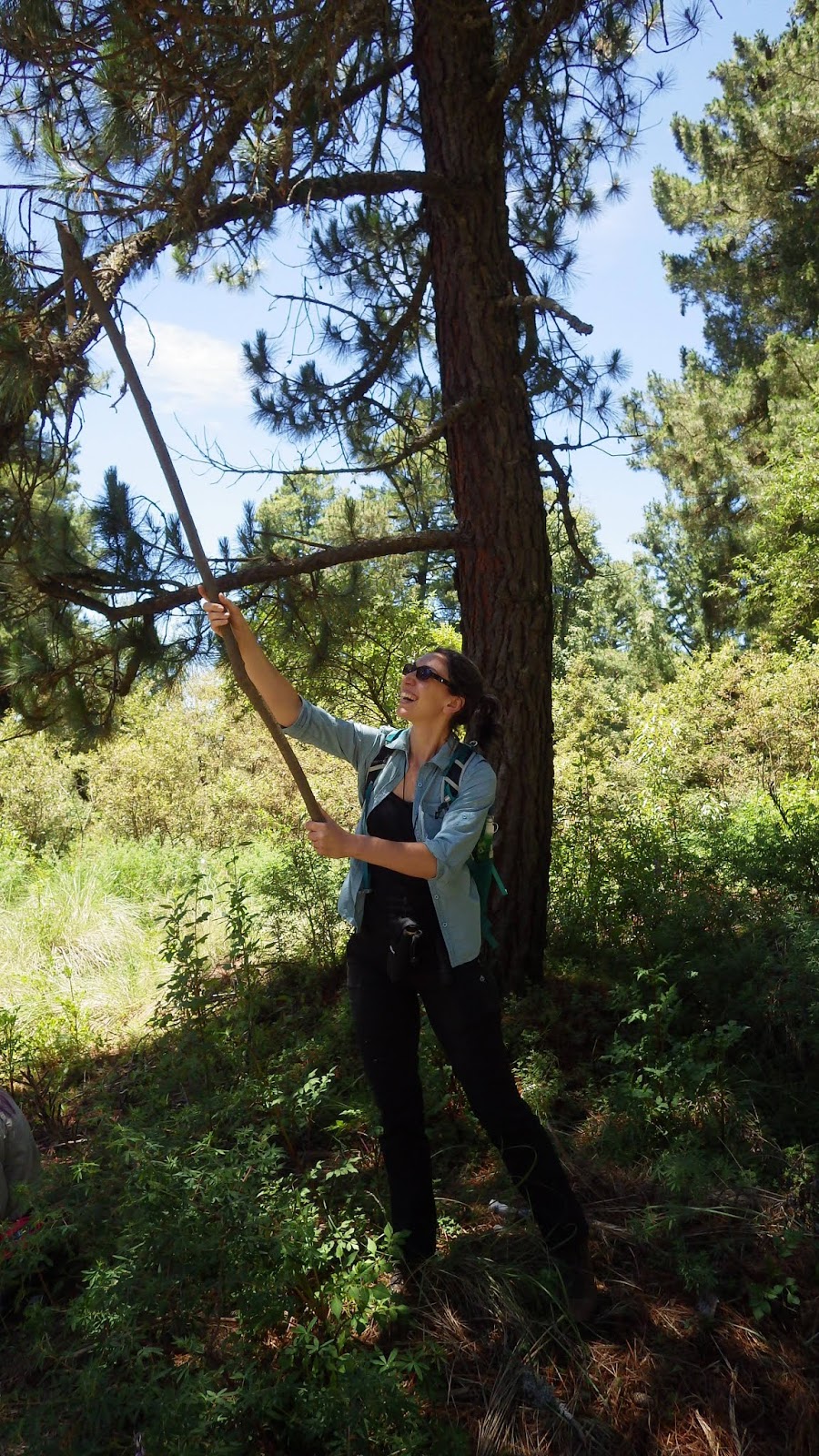
Sarah surveying pines
in central Mexico
Image: Markus Eichhorn
SP: Where to start? I’m an American who lived in England for 12 years and moved to Ireland last year. I’ve always been a nature-lover and have been fortunate enough to do field work in lots of different habitats around the world, looking at reptiles, birds, and mammals as well as plants. 

My interest in botany was sparked during my undergraduate studies in the US, but my botanical skills really improved when I did a PhD focusing on the effects of climate change on a grassland study system at Imperial College’s Silwood Park campus...

LM: Ooh sorry to interrupt but… Silwood Park? Did you study under Prof. Mick Crawley, the co-author (with Clive Stace) of the New Naturalist ‘Aliens’ book, the man behind the Daffodil Key, the Snowdrop Key…  ?

SP: Mick wasn't my supervisor, but I definitely asked for help with grass ID on more than one occasion! It was great to have someone so knowledgeable and approachable on hand.

Sarah leading an OPAL water survey
Image courtesy of Nature in Mind
LM: I’ll bet it was! And your PhD sounds really interesting too. So what did you do after that?

SP: Following my PhD, I worked as a Community Scientist on the Open Air Laboratories (OPAL) citizen science project at the University of Nottingham. That gave me the chance to help thousands of people get more engaged with nature and introduce them to simple methods of ecological recording. 

Then, last summer my son was born and my family moved to Ireland. I’ve spent the last year settling in and getting to know my new home.

LM: So you have experience of botanising in England and are now getting to know Ireland! 

I understand you’ll be splitting your time as Ireland Officer between Dublin and Cork? That will give you a chance to see lots of different plants!

Sarah on an Aquatic
Plant Project training day
Image: Edwina Cole
SP: That’s right. I’ll mostly be working from home in Cork but will be based at the National Botanic Gardens in Dublin a couple of days per month. 

I’ll also be travelling around Ireland when I can to join recording trips and other events. I’ve managed a few recording days in the south and midlands so far but will be looking to join events in other regions soon.

LM: So now you are BSBI’s Ireland Officer and I guess you’ve been thrown in at the deep end – if you’ll forgive the pun – as the Aquatic Plant Project is now well underway! I know Paul Green is at the helm but I imagine there’s quite a lot of work for you to do there?

SP:  Paul has done a great job getting the project off the ground in a really short amount of time! I’ve been helping on the administrative side of things, which has taken a fair amount of time, but I’m just excited to see that it’s been such a success!

Sarah at Cronohill with members of
the Cork local recording group
Image: Finbarr Wallace
LM: Are you finding time to get out in the field or is it office work all the way?

SP: It has been mostly office work so far, but I am trying to get out when I can. 

I managed to join the field meeting in Youghal in July, which was a lot of fun. In August, I met up with the Cork local group for a recording day at Cronohil and I had the chance to survey a beautiful site in Kerry for Hammarbya paludosa (Bog Orchid), which was a first for me. 

I also joined a couple of the Aquatic Plant Project days in the Midlands. 

It was wonderful to get involved after spending so much time on the organising side, and Nick Stewart is a great teacher!

LM: So what else is in your work programme for the next few months?

Sarah and recorders on 
an Aquatic Plant Project
training day
Image: Edwina Cole
SP: The next big thing is the Irish Autumn Meeting, scheduled for 21 September, which should be a really fantastic day and I’m hoping will give me a chance to meet a lot more of our Irish members and County Recorders

I’ll be doing what I can to support our County Recorders in the final push for Atlas 2020, and sorting out a few rare plant surveys too. I’m also looking to revamp the BSBI Ireland webpage, and of course keep on top of our social media accounts. There’s plenty to keep me busy!

LM: And people will be able to follow you on social media, whether on Twitter or on the BSBI Ireland Facebook pages.

SP: That’s right! I’m tweeting from @BSBI_Ireland, and the BSBI Ireland Facebook page, @IrishSectionBSBI, is updated by number of amazing volunteers as well as me.

LM: Well good luck, keep us posted on how you’re getting on and once again – welcome to the BSBI!

SP: Thank you very much! I’m very happy to be here!